VALORANT has nine competitive ranks, starting with Iron and ending with Radiant. Every rank except Radiant contains three divisions, and players move through them by earning or losing Rank Rating.
This guide gives you the full VALORANT rank order first, then explains the current rank distribution, RR, hidden MMR, placement matches, Act Rank and the Competitive rules that affect your climb.
Want VALORANT Points for less? Click the image below to top up VP or get a VALORANT gift card on GamsGo.

VALORANT Ranks in Order
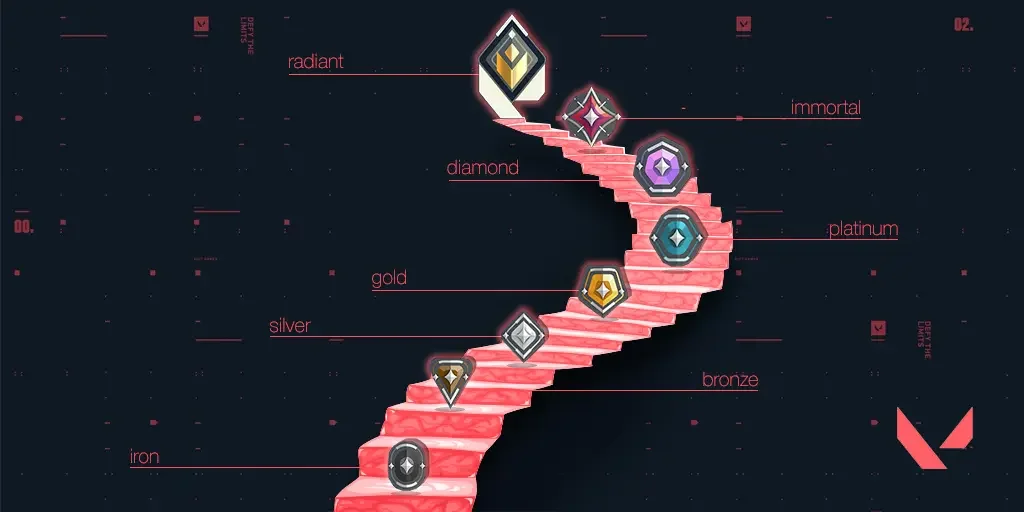
There are nine major VALORANT ranks. Iron through Immortal are divided into three levels, with Division 1 being the lowest and Division 3 being the highest within the same rank.
| Order | Rank | Divisions |
|---|---|---|
| 1 | Iron | Iron 1, 2 and 3 |
| 2 | Bronze | Bronze 1, 2 and 3 |
| 3 | Silver | Silver 1, 2 and 3 |
| 4 | Gold | Gold 1, 2 and 3 |
| 5 | Platinum | Platinum 1, 2 and 3 |
| 6 | Diamond | Diamond 1, 2 and 3 |
| 7 | Ascendant | Ascendant 1, 2 and 3 |
| 8 | Immortal | Immortal 1, 2 and 3 |
| 9 | Radiant | No divisions |
Within the same tier, the higher division is better. Gold 3 is therefore above Gold 1, but Platinum 1 is still higher than every Gold division.
VALORANT Rank Distribution in 2026
The following figures are based on third-party PC match data from VStats for VALORANT V26 Act IV, checked on July 31, 2026. They cover tracked matches across all regions rather than every VALORANT account, so percentages may change as the Act continues.
| Rank | Player Share | Approximate Position |
|---|---|---|
| Iron | 9.93% | Bottom 10% |
| Bronze | 24.16% | Largest rank group |
| Silver | 20.73% | Around the middle |
| Gold | 18.90% | Above the median |
| Platinum | 12.37% | Top 26% approximately |
| Diamond | 10.34% | Top 14% approximately |
| Ascendant | 3.14% | Top 3.6% approximately |
| Immortal | 0.43% | Top 0.5% approximately |
| Radiant | Below 0.01% | Regional elite |
Bronze is currently the largest rank group, followed by Silver and Gold. Just over half of tracked players are in Silver or below, while only around 3.6% reach Ascendant or higher.
Immortal represents substantially less than the top 1% in this snapshot. Radiant is much rarer because players must meet regional RR requirements and hold a qualifying place on their regional leaderboard.
Rank distribution is not fixed. Resets, matchmaking changes, new Acts and the point in the season can all shift these percentages.
How the VALORANT Ranked System Works
VALORANT uses two connected values to manage Competitive progression: visible Rank Rating and hidden Matchmaking Rating.
Rank Rating: The Score You Can See
Rank Rating, usually shortened to RR, shows your progress within the current division. From Iron through Ascendant, reaching 100 RR promotes you to the next division or rank.
- Winning normally adds RR.
- Losing normally removes RR.
- Match result has the greatest influence.
- MMR, opponent strength and individual performance can affect the final change.
- You must lose while at 0 RR before being demoted.
Riot adjusted RR calculations again in Patch 13.00, with the stated goal of making the climb feel less stagnant for players who consistently win. Riot does not publish a simple formula that lets players predict the exact RR change before a match.
MMR: The Hidden Rating Behind Matchmaking
Matchmaking Rating is the hidden value VALORANT uses to estimate your underlying skill and build balanced lobbies. It is separate from the rank badge shown on your profile.
When your MMR is above your visible rank, the system may give you more RR for wins and remove less for losses. When your visible rank is above your MMR, climbing may feel slower until the two values move closer together.
| Feature | RR | MMR |
|---|---|---|
| Visible to players | Yes | No |
| Main purpose | Rank progression | Matchmaking and skill estimate |
| Changes after matches | Displayed immediately | Adjusted in the background |
| Affects RR gains | Not applicable | Yes |
Why Did I Gain Less RR Than My Teammate?
Players in the same match do not always receive the same RR because their hidden MMR, visible rank and performance expectations may be different.
A teammate who is ranked below their estimated skill may gain more RR from the same victory. Another player whose visible rank is already above their MMR may gain less.
Can You Skip a Rank?
Rank skips are possible when the system believes your MMR is significantly higher than your visible rank. This is most likely after strong results across several matches rather than one exceptional game.
Immortal and Radiant RR Explained
Progression changes at Immortal. These players continue to earn and lose RR, but their total RR is also tied to regional rank thresholds and the leaderboard.
Reaching Radiant requires more than simply entering the top 500. A player must both reach the regional Radiant RR threshold and occupy a qualifying top-500 position.
| Rank | Main Requirement |
|---|---|
| Immortal | Accumulate enough RR to meet the regional division thresholds |
| Radiant | Meet the regional RR threshold and remain within the top 500 |
Leaderboard requirements and RR thresholds vary by region. Players also need to remain sufficiently active to keep their leaderboard position displayed.
VALORANT Placement Matches and Rank Resets
How to Unlock Competitive Mode
New accounts must reach Account Level 20 before entering Competitive. This requirement cannot be skipped through VP purchases, skins or gift cards.
How Many Placement Matches Do You Need?
Players entering Competitive for the first time must complete placement matches before receiving a visible rank. Returning players may also need placement games after a major rank reset.
The exact number can depend on whether the account is new and the type of seasonal reset. Minor Act changes generally require less recalibration than major seasonal resets.
What Determines Your Placement Rank?
Placements use your hidden MMR, match results and in-game performance to estimate a suitable starting point. Winning every placement does not guarantee a high rank because the system also considers the difficulty of the lobbies and your previous matchmaking history.
Placement ranks are usually conservative. Your initial badge may therefore appear below your underlying MMR, allowing the RR system to move you upward more quickly if you continue performing well.
Current Rank, Peak Rank and Act Rank
These three terms describe different parts of your Competitive record and should not be treated as interchangeable.
| Term | Meaning |
|---|---|
| Current Rank | The rank currently displayed after your latest Competitive results |
| Peak Rank | The highest rank you reached during the relevant period |
| Act Rank | A record of your Competitive performance and wins during an Act |
How the Act Rank Badge Works
Your Act Rank badge records Competitive results across the Act. It contains ranked-win triangles, with higher-level results replacing lower ones as you build the badge.
Because Riot has changed Act Rank and reward rules in the past, avoid assuming that simply touching a rank, winning nine games at that rank and receiving a reward are always the same condition. Check the current in-client Competitive information before the end of the season.
How Ranked Gun Buddies Work
Ranked Gun Buddies are seasonal rewards tied to proven Competitive performance. Riot has historically connected them to a player’s highest qualifying Act Rank during the relevant season.
The exact reward timing and qualification wording can change, so the current Competitive or reward page in the VALORANT client should be treated as the final source.
VALORANT Competitive Rules You Should Know
| Rule | What It Means |
|---|---|
| Four-player parties | Four-stacks cannot queue for Competitive |
| Five-player parties | Wider rank combinations may queue together, but RR reductions can apply |
| Queue dodging | Can cause RR loss and escalating queue penalties |
| AFK or leaving | Can lead to RR penalties, queue restrictions or stronger action for repeated behavior |
| Remake | May end an early 4v5 without applying a normal loss to eligible remaining players |
| Inactivity | Does not automatically create ordinary RR decay for most ranks |
Riot may increase penalties based on behavior history and repeated offenses. Fixed numbers such as “3 RR for the first dodge and 10 RR for the next” should not be treated as universal rules.
How to Improve Your VALORANT Rank
Understanding RR and MMR helps you interpret your progress, but climbing still depends on winning more rounds and matches over time.
Limit Your Agent Pool
Learn two or three agents well enough to use their utility without stopping to think about every input. Include at least one alternative for situations where your main agent is unavailable or does not suit the team composition.
Improve First-Shot Accuracy
Keep your crosshair near head level, stop moving before firing and avoid turning every mid-range fight into a full spray. A short warm-up is useful, but repeating bad habits for an hour is not.
Trade Instead of Watching
Stay close enough to respond when a teammate takes contact. Entering several seconds after the first player dies often gives the opponent time to reposition and turns a possible trade into another isolated fight.
Manage the Team Economy
Check your teammates’ credits before buying. A coordinated lower-cost round is usually better than one player buying a rifle while the rest of the team saves.
Review Decisions, Not Just Aim
After a loss, look for repeated mistakes: unnecessary peeks, late rotations, unused utility, poor spacing and fights taken without trade support. Fixing one recurring decision can be more valuable than changing your sensitivity again.
Do Weapon Skins Affect VALORANT Rank?
No. Weapon skins do not change weapon damage, recoil, fire rate or accuracy. They also do not affect your MMR, RR or matchmaking.
Some players prefer the sound, animation or visual design of particular skins, but that is a matter of personal comfort rather than a competitive advantage.
Get VALORANT VP for Less on GamsGo
Top up VALORANT Points or choose a VALORANT gift card without sharing or purchasing a ranked account. VP can be used for eligible in-game content but does not affect weapon stats or Competitive matchmaking.
Waiting for a specific skin? Check how the rotating offers work in our VALORANT Night Market guide. You can also claim any available free rewards through the latest VALORANT codes.
Final Thoughts on VALORANT Ranks
The complete VALORANT rank order runs from Iron to Radiant, but the badge alone does not explain every match. RR tracks visible progress, while hidden MMR influences matchmaking and how quickly your rank moves toward the system’s estimate of your skill.
Current V26 Act IV data places most tracked players in Bronze, Silver and Gold. Reaching Ascendant already puts a player within a relatively small part of the ladder, while Immortal and Radiant remain highly exclusive.
Focus on repeatable improvements rather than one match: cleaner gunfights, better trades, coordinated economy and fewer avoidable deaths. Those habits are more reliable than trying to predict an unpublished RR formula.
FAQ
What Is the Highest VALORANT Rank?
Radiant is the highest VALORANT rank. Players must meet their region’s required RR threshold and hold a qualifying position within the regional top 500.
What Rank Is the Average VALORANT Player?
In the V26 Act IV PC data used here, the middle of the player base falls around Silver. Bronze is the single largest major rank group.
What Is the Top 1% Rank in VALORANT?
Immortal generally falls within the top 1% of the Competitive player base. In the current V26 Act IV third-party snapshot, Immortal accounts for approximately 0.43%, with Radiant representing an even smaller group.
Does VALORANT Have Rank Decay?
Most players do not continuously lose RR simply because they stop playing. High-ranked leaderboard players must remain active to keep their leaderboard position visible.
🔍 You Might Also Like: