World of Warcraft: Forever is officially coming. It is not a new WoW Classic season, but a long-term version alongside Modern WoW and Classic WoW. Players will return to a rebuilt Azeroth and level from 1 to 60.
Because every character starts again at Level 1, your class choice directly affects leveling speed, Solo survivability, Dungeon roles, and your later PvE and PvP experience.
This guide compares the announced Warcraft classes across leveling, Solo play, PvE, PvP, difficulty, and role. As the game is still in Beta, final Raid DPS and Meta rankings may change.

WoW Forever 2026 Class Tier List
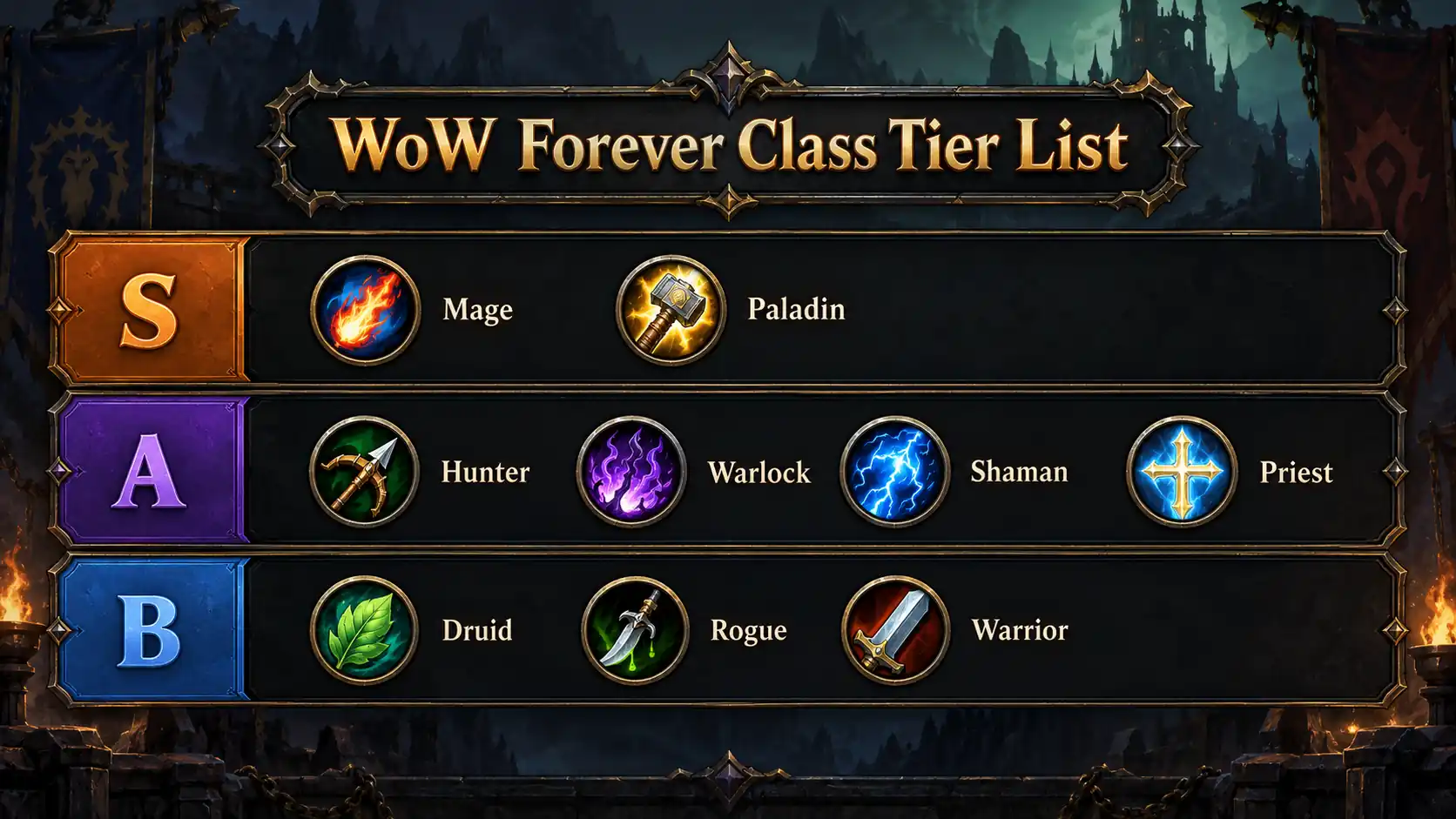
This WoW class tier list ranks classes by their overall performance in leveling, Solo play, PvE, PvP, and difficulty, rather than judging them by DPS alone.
How Are S, A, And B Tiers Defined In WoW Forever?
- S Tier: Excels in several key areas without major weaknesses. These classes usually combine leveling speed, survivability, team value, or strong control.
- A Tier: Performs consistently and stands out in one or two areas, but may have higher skill demands, narrower roles, or weaker Solo survivability.
- B Tier: Has clear strengths but depends more on specific content, gear, player skill, or team setup. It does not mean the class is weak.
- C / D Tier: Not used for now. Beta gear, Raid, and PvP environments are still incomplete, so there is not enough evidence to label any class clearly underpowered.
WoW Forever Class Ranking Criteria
The rankings mainly consider these five factors:
- Leveling Efficiency: Kill speed, sustained combat, and recovery needs.
- Solo Capability: How safely a class handles single targets, multiple enemies, or unexpected adds.
- PvE Value: DPS, Tanking, Healing, control, and team Utility.
- PvP Capability: Burst damage, control, survivability, and mobility.
- Difficulty: The effort needed to manage resources, Pets, forms, Totems, and multiple Roles.
WoW Forever Overall Class Ranking Table
Based on the criteria above, the current overall WoW Forever class rankings are:
Our Test Environment, Ranking Basis, And Beta Limitations
The WoW Forever Beta began on September 17 and runs through October 21. The full version of Forever is scheduled to launch worldwide on November 4.
At this stage, early leveling, rotations, Solo survival, control, and low-level Dungeon value are easier to judge than final Raid DPS or the Level 60 PvP Meta.
Forever keeps a Classic-style pace while reworking Talents, class abilities, and gear. As characters level up, some classes that seem average now may improve significantly.

WoW Forever Class Breakdown
The sections below focus on each class's current role, clear strengths, and ideal players. Beta limits still affect final balance, so early performance should not be treated as the final Meta.
Warrior: Strength, Best Role, And Ideal Players
Warrior keeps a strong Classic identity built around weapons, Rage, melee range, and gear scaling. Without a Pet to absorb damage, Solo leveling requires better control of pulls and health.
Forever still emphasizes Threat and Tank control, allowing Warrior to retain its traditional value in Dungeons.
- Strength: B Tier. Overall performance is stable, but Solo leveling is less forgiving than classes with Pets or reliable healing.
- Best Role: Tank / Melee DPS. Best for players who enjoy melee combat, Threat management, and gear progression, with especially clear value as a Dungeon Tank.
- Main Advantages: Strong weapon progression, a clear melee identity, and access to traditional Tank responsibilities.
- Main Weaknesses: Solo leveling depends more on health, gear, and pull control, while mistakes often require more recovery than Hunter or Warlock.
Best For: Players who enjoy melee combat, traditional Tanking, and learning Threat, resource management, and combat pacing.
Paladin: Strength, Best Role, And Ideal Players
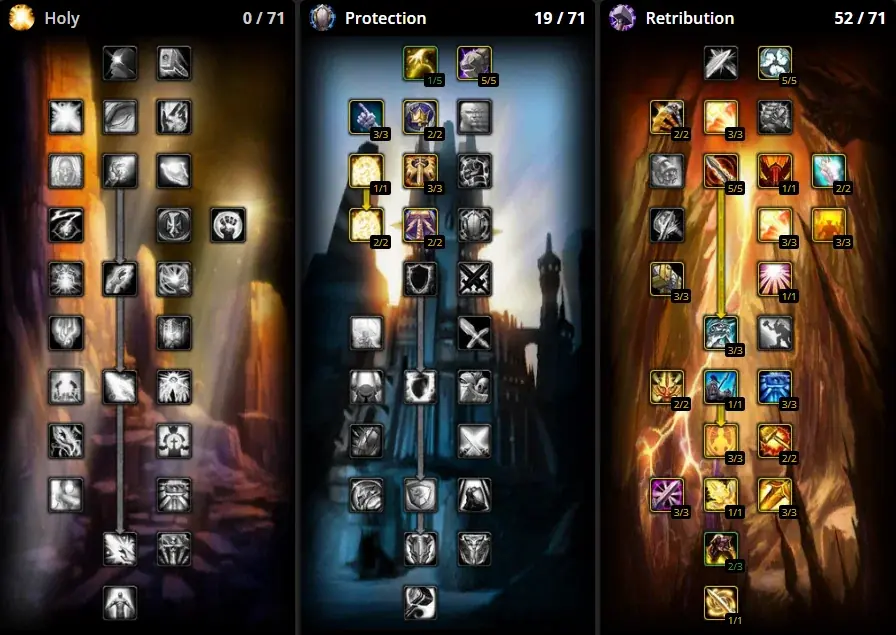
Paladin is one of the most versatile classes in Forever, with Protection, Holy, and Retribution covering Tanking, Healing, and Melee DPS.
Forever gives Hybrid classes clearer specialization roles, making Paladin especially flexible for players who want to invest in one character long term.
- Strength: S Tier. Extremely versatile overall, with strong survivability, team value, and role flexibility even if it does not lead every individual category.
- Best Role: Tank / Healer / Melee DPS. Protection, Holy, and Retribution allow the class to adapt to different team needs.
- Main Advantages: Broad role coverage, strong survivability, solid Solo play, and multiple useful roles in Dungeons and group content.
- Main Weaknesses: Each role needs different talents, gear, and skill knowledge, so maintaining several Roles can increase the learning and gearing burden.
- Best For: New Forever players or anyone who wants one character that can later switch between DPS, Tank, and Healer.
Hunter: Strength, Best Role, And Ideal Players
Hunter's biggest advantage is simple: the Pet can absorb enemy pressure while the player attacks from range. This makes normal quests and Solo play much more forgiving.
For new WoW players, Hunter is valuable not only for damage, but also because it makes distance, Aggro, and repeated combat easier to manage.
- Strength: A Tier. Strong at leveling and Solo play with a low entry barrier, though its team utility and role flexibility are below some Hybrid classes.
- Best Role: Ranged DPS / Solo Leveling. Excellent for ranged combat, questing, stable leveling, and safer outdoor play through Pet support.
- Main Advantages: Pet Tanking, ranged damage, forgiving leveling, beginner-friendly mechanics, and a consistent questing pace.
- Main Weaknesses: Team roles are more limited, while higher-level play requires better Pet control, range management, and Aggro awareness.
- Best For: New WoW players, Solo players, Pet fans, or anyone who values a smooth and reliable leveling experience.
Rogue: Strength, Best Role, And Ideal Players
Rogue is less about standing still and dealing damage and more about controlling fights through Stealth, interrupts, and Crowd Control.
It shines in PvP and precision-control situations, but without a Pet, strong healing, or heavy armor, mistakes can be less forgiving than on Hunter, Warlock, or Paladin.
- Strength: B Tier. Excellent PvP and control tools, but Solo survivability, sustain, and overall team flexibility are more limited.
- Best Role: Melee DPS / PvP. Best for melee players who enjoy Stealth openers, precise control, and PvP-focused gameplay.
- Main Advantages: Strong Stealth, control, interrupts, and disengage tools that let skilled players dictate the pace of combat.
- Main Weaknesses: Limited Pet support and self-healing make multi-target fights and mistakes more dependent on control and player judgment.
- Best For: Players who enjoy PvP, Stealth, control, and high-skill gameplay, and who like planning when to engage or retreat.
Priest: Strength, Best Role, And Ideal Players
Priest remains centered on Healing, Shields, and team support, while Shadow provides a ranged DPS path.
Solo leveling requires more careful Mana, DoT, and recovery management, but Priest becomes especially valuable once Dungeons and group content matter more.
- Strength: A Tier. Excellent team PvE value through Healing and support, although Solo leveling is less forgiving than Hunter or Warlock.
- Best Role: Healer / Ranged DPS. Ideal for Healing, while Shadow keeps a viable ranged damage option.
- Main Advantages: Reliable Healing, Shields, and team support with a clear role in Dungeons and group content.
- Main Weaknesses: Solo play depends more on Mana and recovery management, and sustained questing can feel slower than Pet-based classes.
- Best For: Players who want to heal, support a team, or keep a Shadow DPS option alongside their Healing role.
Shaman: Strength, Best Role, And Ideal Players
Shaman stands out for variety and strong group utility. It can play melee, ranged caster, or Healer, while Totems provide distinctive team support.
Forever also expands several Race/Class combinations, including Dwarf Shaman, giving players more options during character creation.
- Strength: A Tier. Balanced across PvE, PvP, and team Utility, but more complex to manage than a pure DPS class.
- Best Role: Melee DPS / Ranged DPS / Healer. Talents and group needs allow Shaman to shift between damage and Healing.
- Main Advantages: Totems, Healing, several DPS styles, useful team Utility, and strong role flexibility.
- Main Weaknesses: Players must understand Totems, resources, and different rotations, creating a higher learning curve.
- Best For: Players who enjoy Hybrid classes and team Utility and do not mind managing more skills and resources.
Mage: Strength, Best Role, And Ideal Players
Mage combines ranged damage, AoE, Crowd Control, and utility. Forever gives control more value, letting Mage reduce pressure with slows and other control tools.
However, Mage has no Pet to absorb damage. Poor Mana management, over-pulling, or bad positioning can quickly create survival problems.
- Strength: S Tier. Excellent ranged damage, AoE, and control make Mage highly versatile, although its survivability is not the most forgiving.
- Best Role: Ranged DPS / Crowd Control. Excellent for ranged damage, multi-target fights, and Dungeon encounters where enemy control matters.
- Main Advantages: Strong AoE, control, and range, with slows and Roots that let players actively shape each fight.
- Main Weaknesses: No Pet to absorb damage, making Mana, distance, and pull size more important when mistakes happen.
Best For: Players who enjoy ranged spells, AoE, and active control and are willing to learn positioning and resource management.

Warlock: Strength, Best Role, And Ideal Players
Warlock is one of the strongest Solo-focused ranged classes. Demons can absorb enemy pressure while DoTs continue dealing damage as you move or switch targets.
Compared with Hunter, Warlock requires more Pet, DoT, Mana, and health management, but offers more depth in sustained pressure and multi-target combat.
- Strength: A Tier. Strong for Solo play and leveling, with excellent sustain and multi-target pressure, though it is more complex than Hunter.
- Best Role: Ranged DPS / Solo Leveling. Ideal for sustained ranged damage, Solo quests, and situations involving several targets.
- Main Advantages: Demon Tanking, persistent DoT damage, strong sustain, and resource conversion for longer fights.
- Main Weaknesses: Pet, DoT, Mana, and health all need attention, making the resource cycle more demanding than Hunter.
- Best For: Players who enjoy Pets, DoTs, sustained pressure, resource management, and strong Solo capability.
Druid: Strength, Best Role, And Ideal Players
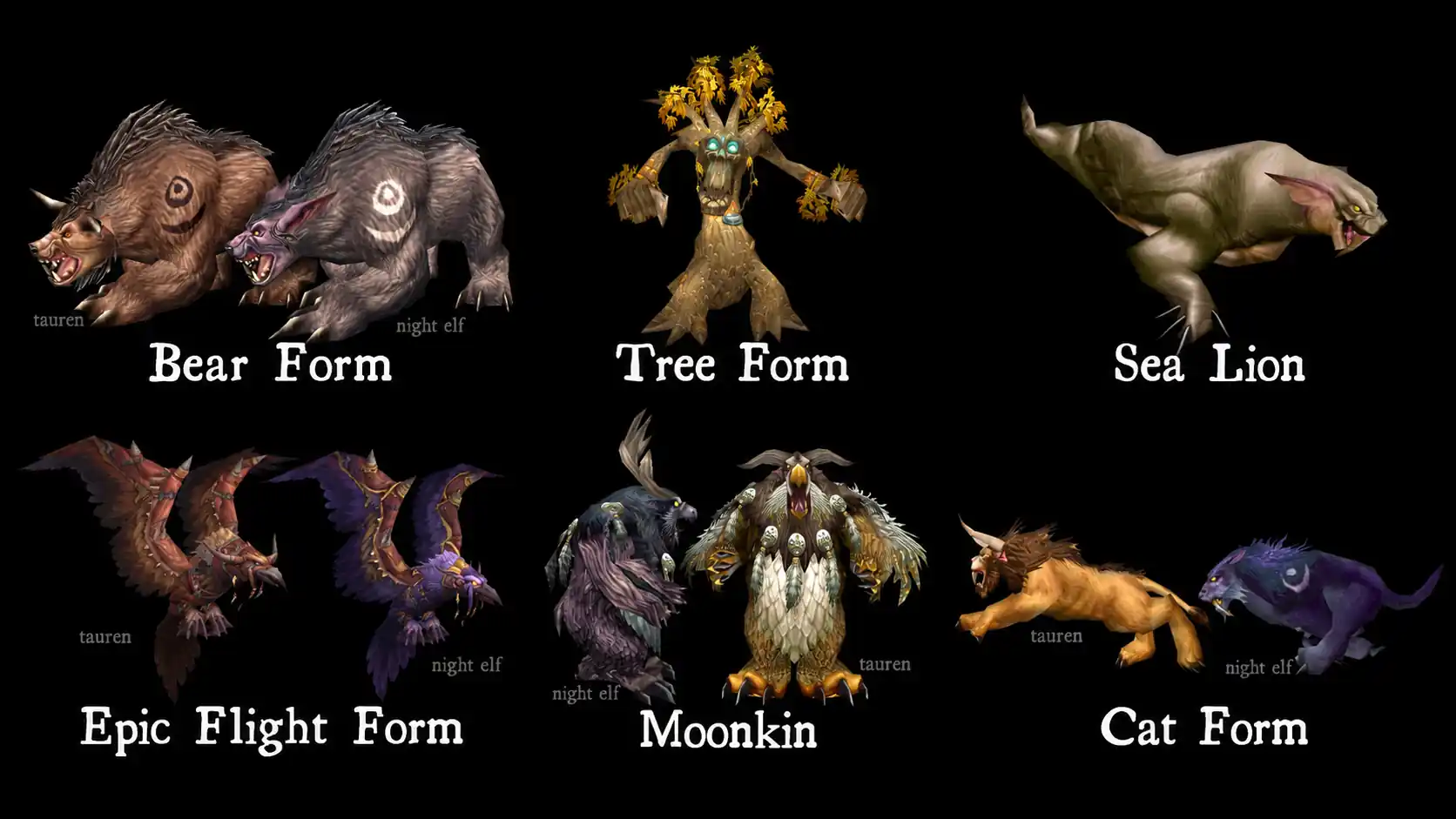
Druid's greatest advantage is also its biggest learning challenge: one class can cover Tank, Healing, Melee DPS, and Ranged DPS.
If you have not chosen a final role, Druid lets you explore more options, but forms, resources, gear needs, and Talent paths also increase complexity.
- Strength: B Tier. Extremely adaptable, but mastering several Roles requires more learning and gear preparation.
- Best Role: Tank / Healer / Melee DPS / Ranged DPS. One of the broadest classes for players who often change roles based on team needs.
- Main Advantages: One character can cover several Roles, giving strong flexibility for Solo play, groups, and long-term progression.
- Main Weaknesses: Forms, resources, Talents, and gear can be complex, especially for new players trying several roles at once.
Best For: Players who enjoy multiple playstyles, run with regular groups, or want to change Roles without leveling another Alt.
Which WoW Forever Class Should Different Players Choose?
Different players need different things from a class. Instead of focusing only on overall Tier, start with the content you play most, such as Solo, Tanking, Healing, PvP, or ranged DPS.
This table is a quick way to narrow your options. Once you know your preferred playstyle, use the class sections above to compare difficulty, team value, Solo strength, and leveling.
How Should Beginners And Solo Players Choose?
For a first Forever character, Hunter, Paladin, and Warlock are strong starting options. Hunter's Pet reduces questing pressure. Warlock also has a Demon, plus DoTs and deeper resource management. Paladin adds defense, Healing, and multiple Role options.
Hunter is the simplest choice. Paladin offers more long-term flexibility, while Warlock suits players who want a Caster with strong Solo performance. Mage is also powerful, but players must learn distance, Mana, and Crowd Control earlier, with less room for mistakes than Pet-based classes.
How Should PvE DPS Players Choose?
It is too early to build a final DPS ranking from early Beta content. High-level Talents, gear, Dungeons, and Raid mechanics will all affect final PvE performance. For pure ranged DPS, consider Mage, Warlock, or Hunter. For melee, look at Rogue or Warrior. Hybrid classes offer more options if one DPS route does not fit your group.
When choosing a Main now, focus on whether you enjoy the class rotation and team utility, rather than chasing DPS numbers that have not yet stabilized.
How Should Tank Players Choose?
The main Tank options are Warrior, Paladin, and Druid. Warrior offers the traditional Tank experience. Paladin combines Tanking with Hybrid flexibility, while Druid uses Bear Form and offers more options to change roles later.
New Tank players who may switch roles later can consider Paladin. Players who want a clear, traditional Tank identity may prefer Warrior.
How Should Healer Players Choose?
Healers can consider Priest, Paladin, Shaman, and Druid. Priest is the most direct Healer. Paladin adds Hybrid flexibility, Shaman brings Totems and Utility, while Druid emphasizes forms and role switching.
Do not judge a Healer only by Healing numbers. Leveling from 1 to 60 still involves plenty of open-world content, so Solo performance also matters.
How Should PvP Players Choose?
Rogue, Mage, and Warlock all have strong PvP toolkits. Rogue controls when fights begin through Stealth. Mage relies on range, Roots, and Crowd Control, while Warlock focuses on DoTs, Fear, and sustained pressure.
Forever also redesigns Racials and adds new race/class combinations, so old Classic PvP race choices cannot simply be copied over. Reliable PvP class ranked lists should wait for Level 60, Battlegrounds, and complete gear environments rather than relying on low-level Duels.
How Could Class Rankings Change After Future Updates?
Beta rankings are better for understanding class playstyles than predicting final Level 60 power. Classes that rely on late Talents, weapons, or full rotations may move the most.
Which Class Rankings Are Most Likely To Change?
Warrior and Rogue may scale strongly with better weapons and gear. Mage and Warlock could gain more from later skills and Talents that improve AoE, control, or sustained damage. Hybrid classes such as Paladin, Shaman, and Druid may also move depending on how their Tank, Healing, and DPS roles perform at higher levels.
Compared with raw damage, traits such as Pets, Healing, Tanking, Crowd Control, and multi-Role flexibility are more stable. The current Tier List is therefore better for understanding what each class does well than for predicting the final Meta.
What Should You Watch After The Full Launch?
After the full release on November 4, rankings should be updated around real gameplay instead of trying to record every possible number.
- Leveling Experience: How smooth Levels 1–60 feel, how often recovery is needed, and how well the class handles multiple enemies Solo.
- Dungeon Performance: Look beyond DPS at Tank stability, Healing pressure, control, and team Utility.
- Gear Scaling: Some classes may start slowly but improve significantly after gaining better weapons or key stats.
- Endgame PvP: Control, survivability, burst, and team combinations need to be tested with complete skills and gear.
- Raid Value: Class demand, Boss mechanics, and group composition will matter once full Raid content opens.
This ranking is best used as a pre-launch class selection guide. After launch, the most useful update will be adjusting Tiers based on real leveling, Dungeon, PvP, and Raid performance.
How Are WoW Forever Classes Different From Classic?
WoW Forever does not completely redesign Classic classes. Instead, it keeps their core identities while improving some specializations that previously felt incomplete.
How Have Skills, Talents, And Class Roles Changed?
Warrior still feels like Warrior and Mage still feels like Mage, but some Talents, abilities, and progression paths are more complete than in old Classic. That can change class roles. Paths that once lacked damage, Healing, Tanking, or useful tools may now have clearer identities in Forever.
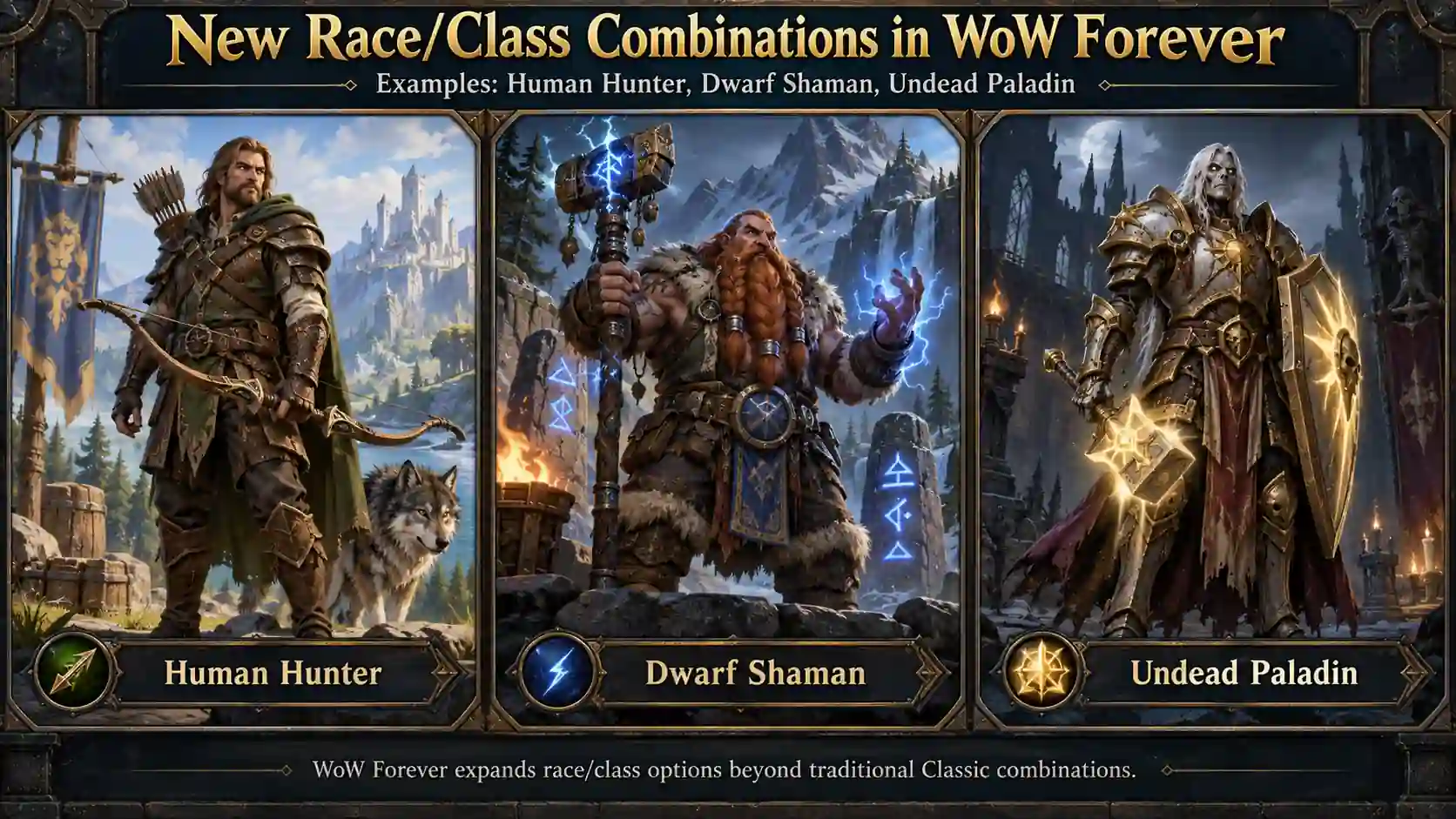
Race/Class options are also expanding. Announced combinations include Gnome Priest, Human Hunter, Dwarf Shaman, Orc Mage, Troll Warlock, and Undead Paladin. These changes show that Forever is not simply copying the old game. It keeps the Classic framework while adding new class choices and progression ideas.
Why Can't Classic Class Rankings Be Used Directly?
Classic rankings were built around old Talents, gear, Raids, and PvP systems. Forever changes those assumptions, so old rankings cannot simply be copied over. Classic Tier Lists can still explain traditional class strengths, but they should not be treated as direct S, A, or B rankings for Forever.
Should Classic Veterans Keep Playing Their Old Main?
Yes. In most cases, there is no need to change classes just because of an early Tier List. If you enjoyed Warrior melee combat, Rogue Stealth, Mage control, or Druid forms, those core class identities still remain in Forever.
What players need to relearn is not the class identity itself, but the new Talent paths, updated tools, and strategies that better fit Forever.
Conclusion
If you have not chosen a launch class, start with your playstyle: Hunter or Paladin for beginners, Hunter or Warlock for Solo, and Mage or Warlock for ranged combat.
If you also need game accounts or in-game items, you can explore relevant products on GamsGo. Before ordering, confirm the server, quantity, and delivery method. GamsGo supports secure payments, order protection, and 24/7 customer support.
We’ve prepared an exclusive promo code for all blog readers:
Enjoy an additional 1% off on your next purchase!
Valid across all categories — streaming accounts, AI tools, game top-ups, software subscriptions, and more.
FAQ
How Many Classes Are There In WoW Forever?
WoW Forever currently includes nine core classes: Warrior, Paladin, Hunter, Rogue, Priest, Shaman, Mage, Warlock, and Druid. Each class has its own combat role, strengths, weaknesses, and Talent options, so your choice can affect leveling, Solo play, PvE, PvP, and group content.
What Is The Best WoW Forever Class For Beginners?
Hunter is one of the easiest starting choices because its Pet can absorb enemy pressure while you attack from range, making Solo leveling more forgiving. Paladin is another strong option if you want better survivability and the flexibility to try Tank, Healing, or Melee DPS later.
Will WoW Forever Class Rankings Change After Launch?
Yes. Current rankings are based on the Beta environment and early class design, so they may change after launch. Level 60 Talents, gear scaling, Dungeon balance, PvP matchups, and Raid mechanics can all affect how strong each class feels once the full endgame becomes available.
Do Best Delve Class Rankings Apply To WoW Forever?
No. Best delve class rankings mainly apply to Modern WoW, where Delves are part of the current content system. WoW Forever uses a different leveling structure, class balance, Dungeon design, Raid environment, and PvP system, so its classes need to be evaluated separately.
Related Articles:
- How to Get Free FC Mobile Points and FC 26 Points (2026)
- How to Get Free FIFA Coins in EA FC 26 & FC Mobile (2026)
- All Working Untitled Boxing Game Codes (August 2026)
- Clash of Clans Gold Pass 2026: Price, Rewards & Worth It?
- FC Mobile - All Active Redeem Codes September 2026
- EA FC 27 Leaks: The Grounds, Icons & FUT Changes