Codex has become one of the most popular AI coding tools, with over 5 million weekly users reported by OpenAI in June 2026. And the good news? You no longer need a paid ChatGPT plan to try it. Since July, Codex has been available in the ChatGPT desktop app, including on the Free plan.
However, Codex Free comes with limits. It uses the lighter GPT-6 Luna model, while more advanced features like GPT-6.1 Sol, cloud tasks, and automatic GitHub code reviews typically require a paid plan. Fortunately, there are still ways around some of these costs. This guide covers 8 ways to use Codex for free or at a lower cost in 2026, without relying on expired offers.
For those who want full access without waiting for special offers or meeting eligibility requirements, GamsGo offers a Codex Plus subscription with up to 35% off, making it a more affordable alternative to subscribing directly through OpenAI.
📑 Quick Guide: 8 Methods Covered
Free access to the full Codex toolset:
- Free ChatGPT Plus offers (Codex included)
- Codex for Open Source (6 months free)
- ChatGPT Edu through your university
- Cheaper Codex through GamsGo (paid alternative)
- Codex promotions and limited-time offers
👇 Free Codex without any paid plan:
- Codex credits for students ($100)
- OpenAI Researcher Access Program (API credits)
- Codex CLI with local models
What's the Difference Between Codex Free and Plus?
Every ChatGPT plan now includes Codex, so the question is how much of it each plan unlocks. Free and Plus are the two plans most individual developers end up choosing between, and the gap between them is wider than the $20 price suggests.
What You Get With Codex Free
OpenAI pitches the free plan as a way to try Codex on quick coding tasks. It runs GPT-6 Luna at Standard speed, the lower-cost member of the GPT-6 family, and OpenAI's plan card names the ChatGPT desktop app as the place to use it, with access still rolling out.
The Help Center lists the CLI, IDE extension, and web app as sign-in options without tying them to a plan, and developers have reported free accounts running Luna in recent CLI builds, but Codex Cloud is excluded from Free.
OpenAI publishes no usage numbers for Free. When you hit the cap, you wait for the reset time shown in your usage dashboard or upgrade. A limited group of Free users can also buy credits, though buying them does not raise the plan's included limit.
What Codex Plus Adds
Plus costs $20 a month and opens Codex on the web, in the CLI, in the IDE extension and on iOS. It adds GPT-6.1 Sol for harder work, keeps GPT-6 Luna for quick jobs, and includes a small allowance of GPT-6 Astra. Cloud tasks, automatic code review on GitHub, and the Slack integration are all part of the plan.
OpenAI estimates that a Plus account gets 15 to 160 GPT-6.1 Sol messages or 350 to 3,000 GPT-6 Luna messages per five-hour window, with weekly limits on top. The five-hour window returned for Plus on August 25, 2026, after a summer break, and Plus users who run out can buy credits instead of waiting.
Whether the plan earns its $20 also depends on how much you use ChatGPT outside Codex, which our ChatGPT Plus review looks at in detail.
Codex Free vs Plus at a Glance
The table below lines up the two plans feature by feature.
| Feature | Codex Free | Codex Plus |
|---|---|---|
| Price | $0 | $20 a month |
| Models | GPT-6 Luna at Standard speed | GPT-6.1 Sol, GPT-6 Luna and a small GPT-6 Astra allowance |
| Where the plan card lists Codex | ChatGPT desktop app | Desktop app, web, CLI, IDE extension and iOS |
| Codex Cloud tasks | Not included | Included |
| GitHub code review and Slack | Not included | Included |
| Published usage estimates | None | 15 to 160 Sol or 350 to 3,000 Luna messages per five hours |
| Buying extra credits | Limited group of users only | Available |
| Image generation in Codex | Not available | Available |
Free is enough to see how Codex works on small tasks. Plus is where it becomes a daily tool, because the stronger model, cloud tasks and GitHub reviews all live there.
Two other personal plans sit around them. Go costs $8 a month and gets the same GPT-6 Luna access in the desktop app as Free, aimed at lightweight tasks. Pro starts at $100 a month, with $200 and $500 tiers, and currently has no five-hour limit, while the $500 tier adds Ultrafast mode. Our ChatGPT pricing breakdown compares all of these plans beyond Codex.
Can You Get Codex for Free in 2026?
Yes, and on more than one level.
Anyone with a ChatGPT account can use Codex Free today. When the Codex app launched on February 2, 2026, OpenAI opened it to Free and Go users for a limited time, and that access later became a permanent part of both plans. What stayed behind the paywall is the full toolset: GPT-6.1 Sol, cloud tasks, and GitHub code review.
Using that full toolset without paying is also possible, just not for everyone. Free ChatGPT Plus offers cover selected accounts, US veterans and students, Malta residents and Grab partners, while OpenAI runs Codex programs of its own for open-source maintainers and university students.
Codex also works for free on top of a Free account through student credits, research credits, or local models.
How to Get Codex for Free?
Each route below gives you the full Codex toolset without paying OpenAI, for anything from one month to a year. Since Codex comes with ChatGPT Plus, the first one groups the current ways to get ChatGPT Plus for free and shows what each means for Codex. The rest are programs and offers built around Codex itself.
Free ChatGPT Plus Offers (Codex Included)
Codex is part of every Plus subscription, so a free month of Plus is also a free month of the full Codex toolset: GPT-6.1 Sol, the CLI and IDE extension, cloud tasks and GitHub reviews. Six Plus offers still work in 2026:
| Offer | Free Codex Period | Who Qualifies | Watch Out For |
|---|---|---|---|
| Trial invites from OpenAI | Usually 1 month | Accounts OpenAI selects, mostly new and Free users | Some need a card and renew automatically |
| Retention offer when cancelling | 1 free month or 50% off for 3 months | Some paying Plus subscribers | Undocumented and not shown to everyone |
| US veterans offer | 12 months | Veterans who left active duty in the past 12 months, or will within 12 months | ID.me check, renews after the year |
| Back-to-school offer | 4 months | US college and graduate students | Claim by October 31, 2026, card required |
| Malta's AI for All | 12 months | Maltese e-ID holders aged 14+ who finish the course | Not valid on accounts already paying |
| Grab partner workshops | 3 months | Grab drivers, delivery and merchant partners, Singapore first | No public sign-up |
Trial invites are the only option open to anyone, and only when OpenAI picks your account. The claim steps for each offer are in the guide linked above, and OpenAI's trial invite FAQ explains how invites renew.
What matters for Codex is what happens when the free period ends. Most of these offers roll into a paid Plus plan unless you cancel, and Malta's does not renew at all.
Either way, an account that drops back to Free keeps Codex but loses GPT-6.1 Sol, cloud tasks and GitHub reviews, so finish any cloud work before the end date. Students outside the US can find other options in our ChatGPT student discount guide.
Codex for Open Source (6 Months Free)
This is the most generous free Codex offer OpenAI runs. Maintainers accepted into the program use Codex on ChatGPT Pro for six months, with no five-hour limit under Pro's current rules.
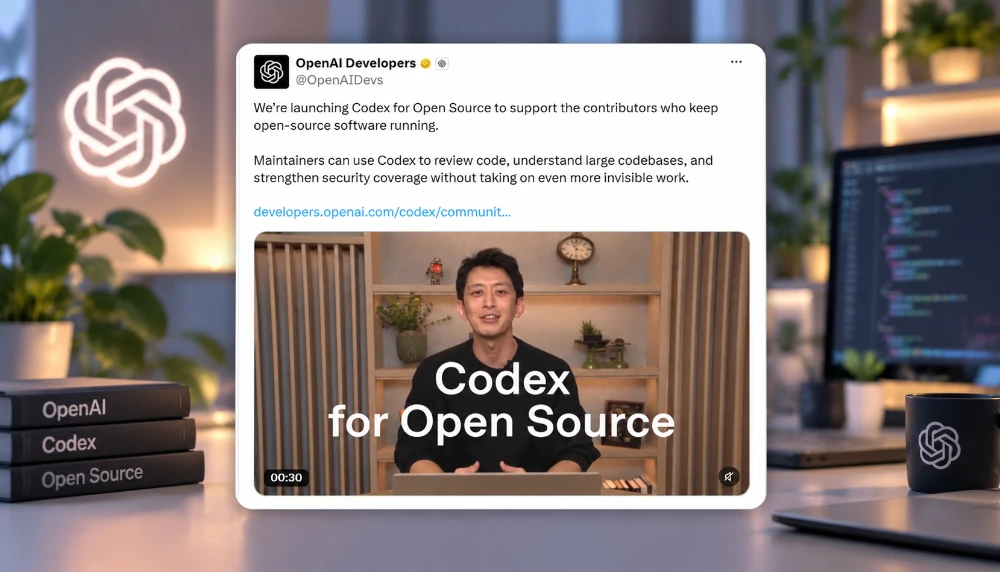
Projects that use Codex for pull request review or release automation can also receive API credits from the Codex Open Source Fund, with grants of up to $25,000, and core maintainers with write access can be considered for Codex Security.
OpenAI looks for primary or core maintainers of a public repository, with a public GitHub profile and visible upkeep such as reviewing pull requests, triaging issues or shipping releases. A project that misses one of these can still apply if it plays an important role in its ecosystem.
The application form asks for your ChatGPT email, GitHub username, repository URL, and OpenAI Organization ID, and reviews happen on a rolling basis with replies by email.
OpenAI does not say which Pro tier maintainers receive, and its terms leave room for benefits to vary between applicants.
ChatGPT Edu Through Your University (School-Dependent)
A growing number of universities buy ChatGPT Edu for their students and staff, and Codex is part of that plan. If your school is one of them, sign in to the ChatGPT desktop app or the Codex CLI with your school account and see whether Codex is there. Access costs you nothing, and the limits and models are whatever your school has set.
The catch is that Codex has to be switched on. OpenAI's guide for universities tells workspace owners to enable local Codex and device-code sign-in for the CLI, and GPT-6.1 Sol stays off in Edu workspaces until an admin turns it on. If Codex is missing, your IT or digital learning team is the one to ask.
Cheaper Codex Through GamsGo (Paid Alternative)
Not everyone qualifies for student discounts, veteran offers, or open-source programs, and waiting for an invitation isn't always practical. If you need more Codex access now, GamsGo offers a discounted Codex subscription with three options: Codex Plus for $15.49, Pro 100 for $68.99, and Pro 200 for $145.99.
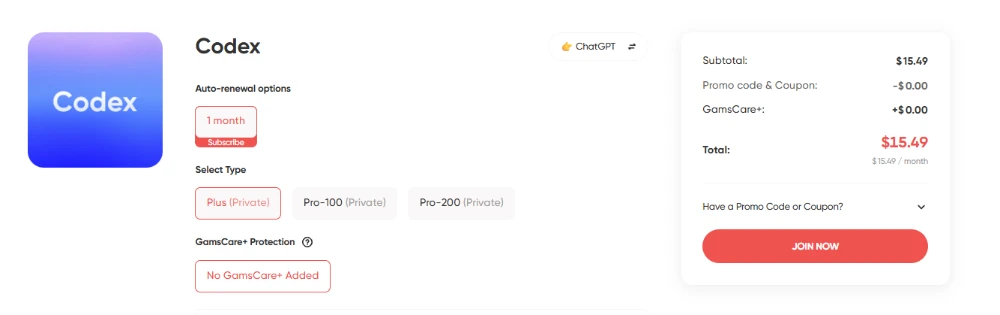
Compared with OpenAI's official prices, that's a saving of up to 31%, with higher-tier plans offering larger usage allowances for demanding coding projects.
GamsGo also offers other AI subscriptions, including ChatGPT Plus accounts, Claude Pro accounts, and Gemini Pro accounts, all with the same convenient purchasing experience. There's also no automatic renewal, so you won't need to worry about unexpected recurring charges.
Every order is covered by GamsGo's DealShield protection, which holds your payment until you confirm everything works and provides refunds for unresolved issues. With 24/7 customer support, you also have help available if anything goes wrong. For more ways to save on ChatGPT subscriptions, check out our ChatGPT discount guide.
Codex Promotions and Limited-Time Offers (Irregular)
OpenAI tends to attach Codex offers to launches, and most last a few weeks. These are the ones that ran in 2026:
- The February launch promotion, which added Free and Go access and doubled paid limits until early April
- A two-week referral program in June, where Plus and Pro users and the friends they invited each banked a Codex rate-limit reset
- ChatGPT for Academic Researchers, which gives eligible faculty and postdocs 12 months of free access across ChatGPT, ChatGPT Work and Codex, with applications set to reopen later this fall
- A two-month free offer for new Codex users on enterprise accounts, which OpenAI has now closed
New offers usually appear in OpenAI's Codex changelog and as banners in the app. Banked resets from referrals have to be used within 30 days of landing in your account.
How to Use Codex for Free Without a Paid Plan?
The next three methods involve no paid plan at all. They add free Codex usage to a Free account, or let you run the Codex CLI without a ChatGPT account.
Codex Credits for Students ($100)
University students in the United States and Canada can add 2,500 Codex credits, worth $100, to an ordinary Free account. Open the Codex for Students page while signed in to ChatGPT Free, Go, Plus or Pro, verify through SheerID with your university email, and the credits land in your personal workspace. Your ChatGPT account does not have to use the school address.
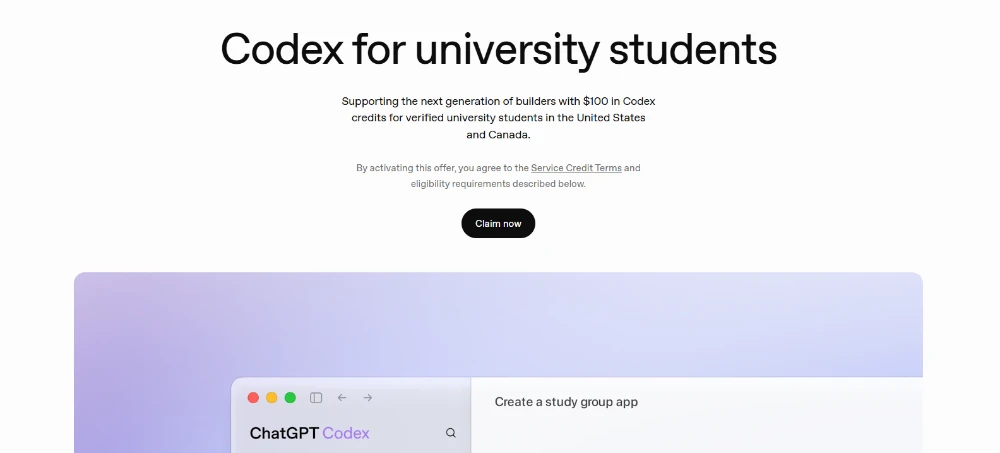
You must live in the US or Canada when you claim, each student gets the offer once, and the credits expire 12 months after they arrive. Because credits are spent by tokens, how far they go depends on the model. OpenAI estimates a typical GPT-5.6 Sol task at 2 to 15 credits, which works out to roughly 170 to 1,250 tasks on that model.
If you are building a free student toolkit, the GitHub Copilot student discount is worth claiming alongside these credits.
OpenAI Researcher Access Program (API Credits)
OpenAI's Researcher Access Program grants up to $1,000 in API credits to researchers whose proposals it approves, with applications reviewed once a quarter and credits valid for a year. The program is not built around Codex, but the credits can pay for it.
Sign in to the Codex CLI or IDE extension with an API key from the funded organization, and Codex bills tokens at API rates, such as $0.10 per million input tokens and $0.50 per million output tokens on GPT-6 Luna. The credits absorb that cost. API-key sessions skip cloud features like GitHub code review and Slack, so this covers local coding work only.
Codex CLI With Local Models
The Codex CLI is open source under the Apache-2.0 license, and its --oss mode runs open-weight models on your own computer through Ollama or LM Studio. Setting it up takes four steps:
- Install the CLI with
npm install -g @openai/codex, or withbrew install --cask codexon a Mac. - Install Ollama or LM Studio and download an open-weight model such as gpt-oss-20b.
- In Ollama, raise the context window to at least 64K tokens, which Ollama's Codex guide recommends.
- Run
codex --oss, adding--local-provider lmstudioif you use LM Studio instead of Ollama.
Local mode needs no OpenAI sign-in and no usage limit applies, but the work runs on your hardware. The default gpt-oss-20b model needs about 16 GB of memory, and an open-weight model running locally will not match GPT-6.1 Sol on large, multi-file changes.
Which Free Codex Method Is Right for You?
The table below compares all 8 methods by what they give, how long they last and who can use them.
| Method | Codex Access | How Long | Who Can Use It | Effort |
|---|---|---|---|---|
| Free ChatGPT Plus offers | Full Codex (Plus plan) | 1 to 12 months | Invited accounts, US veterans and students, Malta, Grab partners | Low to medium |
| Codex for Open Source | Full Codex (Pro plan) and API credits | 6 months | Core maintainers | High (review) |
| ChatGPT Edu | Codex in a school workspace | Set by your school | Students at Edu schools | Low, if enabled |
| GamsGo Codex Plus | Full Codex (Plus plan), paid | 1 month per order | Anyone | Low |
| Codex promotions | Varies | Usually weeks | Depends on the offer | Low, when running |
| Student credits | $100 in Codex credits | 12 months | US and Canadian university students | Medium (SheerID) |
| Researcher Access Program | Up to $1,000 in API credits | 12 months | Approved researchers | High (proposal) |
| CLI with local models | Codex CLI on open-weight models | No time limit | Anyone with 16 GB+ memory | Medium (setup) |
Most readers will qualify for two or three of these at most, so start with the ones your situation already matches.
If you are a student in the US or Canada, the $100 in Codex credits is the easiest win, and US students can also claim the back-to-school Plus offer before October 31. Open-source maintainers get the most value from the six months of Pro, while veterans, Malta residents and Grab partners each have a Plus offer that lasts three to twelve months.
Everyone else is choosing between stretching Codex Free, waiting for a trial invite, coding with local models or paying less for full Codex. Local models suit privacy-sensitive or offline work, while a discounted plan gives you GPT-6.1 Sol and cloud tasks straight away.
If you are still choosing between coding agents, our Codex vs Claude Code comparison shows where each one is stronger, and the same kind of free routes for Anthropic's agent are covered in how to use Claude Code for free.
How to Make Codex Free Last Longer?
If none of the routes above fits and you stay on Codex Free, it helps to know how the free allowance is spent. Codex measures usage in a short rolling window, usually five hours, with a weekly limit on top, and OpenAI notes that longer and more complex tasks use more of it than short ones.
Free has no published message count, so the usage dashboard in Settings is the only place to see how much is left and when it resets.
A few habits stretch the same allowance further:
- Give Codex one clearly scoped task per request, such as fixing a named function, instead of an open brief like "improve this app".
- Point it at the files that matter rather than the whole repository, since everything Codex reads is counted as usage.
- Check the dashboard before a larger job, so a refactor does not stop halfway when the window runs out.
- Save quick questions about syntax or concepts for ChatGPT's chat, and keep Codex for work that touches your files.
None of these raise the limit, but they keep it from being spent on requests that did not need an agent.
When the window does run out, a Free account has three options: wait for the reset time shown in the dashboard, redeem ChatGPT credits if someone has gifted them to you, or move to a plan with a larger allowance through one of the routes above.
Conclusion
Codex itself costs nothing to start with: the Free plan gives you GPT-6 Luna in the ChatGPT desktop app, and careful use of its allowance goes a long way on small tasks. Using the full toolset for free depends on who you are.
Open-source maintainers and university students have Codex programs of their own, and several free ChatGPT Plus offers bring full Codex along with them.
If none of those apply, a GamsGo Codex Plus subscription costs less than OpenAI's monthly price and starts right away. We recheck these offers against OpenAI's pages as they change, since several of the 2026 promotions lasted only a few weeks.
FAQ
Can You Use the Codex CLI on the Free Plan?
Possibly. OpenAI's pricing card names only the desktop app for Free, but its Help Center lists the CLI among the sign-in options for every plan, and developers have reported free accounts running GPT-6 Luna in recent CLI builds. Cloud tasks and GitHub code review still require Plus or higher.
Will a Free Codex Trial Renew Automatically?
In most cases, yes. Free Codex trials come as Plus promotions, and OpenAI says most of them renew at the standard Plus rate when the free period ends, and some invites require a payment method up front. Set a reminder a few days before the end date and cancel in your account settings if you do not want to keep paying.
Do These Methods Work Outside the US?
Several do. The Free plan, trial invites and Codex for Open Source have no stated country rule, Malta and Grab are local programs, and the student credits cover the US and Canada. The veterans and back-to-school offers are limited to the US, while ChatGPT Edu depends on your university.
What Is the Difference Between Codex Free and Go?
Both plans run GPT-6 Luna at Standard speed in the ChatGPT desktop app, and neither includes Codex Cloud. Go costs $8 a month and is aimed at lightweight coding tasks, while Free is pitched at quick ones. OpenAI publishes no usage numbers for either, so the difference is mainly how much you can do.
Is Codex Free With ChatGPT Plus?
Yes. Codex costs nothing extra on ChatGPT Plus, so a Codex Plus subscription and ChatGPT Plus are the same $20 plan. It covers Codex on the web, CLI, IDE extension and iOS, plus cloud tasks, GitHub code review and GPT-6.1 Sol, and lets you buy credits when you reach a limit.