Claude AI API is developed by Anthropic for adding Claude models to apps, coding editors, workflow automations, and AI assistants. Anthropic is now serving over 300,000 commercial clients, which demonstrates how rapidly Claude progressed from research to production mode.
The base rates are between $1-$10 per million of input tokens and $5-$50 per million of output tokens; however, caching, tools, traffic, and cloud routing affect the final price. Based on official 2026 prices, we evaluate different models, compute the cost, describe credits and free access policy, and contrast Claude API with Claude Code and other plans.
Should you want a Claude API with discounts, GamsGo provides reduced bundles with adjustable credit limits, current versions of Claude models, quick online delivery, and up to 90% discounts for some offers. Click on the banner below to see them.

Claude API Terms You Should Know
What Is the Claude AI API?
Claude AI API is a way to connect to Claude directly via your app. Your software sends Claude a message without opening a chat window and typing a prompt.
In such a way, you can integrate Claude into a code editor, customer service platform, document processing system, and any other tool where you want to have an interaction. All requests processed by Claude process some amount of input and output tokens.
Buying the requests is similar to paying with a transit card: you fill up your balance with dollars by purchasing API credits, and each request subtracts a different amount depending on the model, tokens, caching, and tools you use.
API Key indicates the balance that you are paying for. You do not buy a fixed number of tokens for one particular model, and when your balance reaches zero, requests are stopped until you purchase new credits.
The terms below will clarify all steps and allow you to understand the pricing tables and cost calculations of this guide.
| Term | Definition |
|---|---|
| API key | A secret credential that identifies and authenticates your API requests. |
| Access token | A short-lived Bearer token created through Workload Identity Federation as an alternative to an API key. |
| Base URL | The root address to which your application sends API requests. |
| Endpoint | A specific API path that performs an action, such as sending a message or listing models. |
| Request method | An HTTP command such as GET, POST, PUT, or DELETE that tells an endpoint what to do. |
| API call | One exchange in which your application sends a request and the API returns a response. |
| Request body | The JSON data sent in a request, including the model, messages, tools, and output limit. |
| API response | The data returned by the API, including Claude's output, usage details, and request metadata. |
| Status code | A three-digit result code. 2xx means success, while 4xx and 5xx indicate errors. |
| SDK | A development toolkit that handles request formatting, authentication, streaming, retries, and errors. |
| Token | A small unit of text processed by Claude. One million tokens is abbreviated as MTok. |
| Input tokens | The content Claude reads, including prompts, history, files, images, and tool results. |
| Output tokens | The response and thinking tokens generated by Claude. |
| Prompt cache | Stored prompt content that Claude can reuse instead of processing it again. |
| Cache write | The first time content is stored in the prompt cache for later use. |
| Cache hit | A request that reuses cached content at 10% of the standard input price. |
| API credits | A prepaid balance used to pay for Claude API, Playground, and API-billed Claude Code usage. |
| Batch API | An asynchronous service that processes Messages requests with 50% lower input and output prices. |
| Rate limit | A traffic cap measured through requests per minute (RPM) and tokens per minute (TPM). |
| Spend limit | The maximum API cost an organization or workspace can incur during a month. |
| Pagination | A method that divides long lists into pages and uses a cursor to retrieve the next set of results. |
Claude AI API Price in 2026
Claude API uses pay-as-you-go pricing rather than a fixed monthly subscription. Rates start at $1 per million input tokens and $5 per million output tokens, with Haiku 4.5 as the cheapest current model and Fable 5 and Mythos 5 at the highest rates.
Your bill depends on how many input, output, cache, and tool-use tokens each request processes. Anthropic lists these rates per MTok, meaning one million tokens, so the table below shows each model’s price in USD per MTok.
| Claude Model | Base Input | 5-Minute Cache Write | 1-Hour Cache Write | Cache Hit | Output |
|---|---|---|---|---|---|
| Latest Claude Models | |||||
| Claude Fable 5 | $10 / MTok | $12.50 / MTok | $20 / MTok | $1 / MTok | $50 / MTok |
| Claude Mythos 5 Limited Availability | $10 / MTok | $12.50 / MTok | $20 / MTok | $1 / MTok | $50 / MTok |
| Claude Opus 5 | $5 / MTok | $6.25 / MTok | $10 / MTok | $0.50 / MTok | $25 / MTok |
| Claude Sonnet 5 | $2 / MTok | $2.50 / MTok | $4 / MTok | $0.20 / MTok | $10 / MTok |
| Claude Haiku 4.5 | $1 / MTok | $1.25 / MTok | $2 / MTok | $0.10 / MTok | $5 / MTok |
| Previous Claude Models | |||||
| Claude Opus 4.8 | $5 / MTok | $6.25 / MTok | $10 / MTok | $0.50 / MTok | $25 / MTok |
| Claude Opus 4.7 | $5 / MTok | $6.25 / MTok | $10 / MTok | $0.50 / MTok | $25 / MTok |
| Claude Opus 4.6 | $5 / MTok | $6.25 / MTok | $10 / MTok | $0.50 / MTok | $25 / MTok |
| Claude Opus 4.5 | $5 / MTok | $6.25 / MTok | $10 / MTok | $0.50 / MTok | $25 / MTok |
| Claude Opus 4.1 Retired Except on Bedrock and Google Cloud | $15 / MTok | $18.75 / MTok | $30 / MTok | $1.50 / MTok | $75 / MTok |
| Claude Opus 4 Retired Except on Google Cloud | $15 / MTok | $18.75 / MTok | $30 / MTok | $1.50 / MTok | $75 / MTok |
| Claude Sonnet 4.6 | $3 / MTok | $3.75 / MTok | $6 / MTok | $0.30 / MTok | $15 / MTok |
| Claude Sonnet 4.5 | $3 / MTok | $3.75 / MTok | $6 / MTok | $0.30 / MTok | $15 / MTok |
| Claude Sonnet 4 Retired Except on Bedrock and Google Cloud | $3 / MTok | $3.75 / MTok | $6 / MTok | $0.30 / MTok | $15 / MTok |
| Claude Haiku 3.5 Retired Except on Bedrock and Google Cloud | $0.80 / MTok | $1 / MTok | $1.60 / MTok | $0.08 / MTok | $4 / MTok |
If most of your API spending comes from terminal-based coding, compare the estimate with our Claude Code pricing guide. A Pro or Max subscription may be easier to budget for regular individual use.
Sonnet 5 remains at $2 per input MTok and $10 per output MTok. Anthropic cancelled the increase to $3 and $15 that was previously planned for September 2026.
Older does not always mean cheaper. Opus 4.1 and Opus 4 cost $15 per input MTok and $75 per output MTok, which is three times the standard Opus 5 rate.
Claude 4.7 and newer models use a newer tokenizer that may produce about 30% more tokens for the same text. You should count tokens with your selected model before comparing the final cost.
What Are You Paying for in a Claude API Request?
Your model rate is only the starting point. A request can include input, output, prompt caching, paid tools, or managed-agent runtime, depending on the features you use.
| Usage Type | What It Includes | How You Pay |
|---|---|---|
| Base Input | System prompts, user messages, history, files, images, tool definitions, and tool results | The model’s base input rate |
| Output | Claude’s visible response and tokens used for thinking | The model’s output rate |
| 5-Minute Cache Write | Prompt content stored for reuse for five minutes | 1.25× the base input rate |
| 1-Hour Cache Write | Prompt content stored for reuse for one hour | 2× the base input rate |
| Cache Hit | Previously cached prompt content reused in another request | 0.1× the base input rate |
| Paid Server Tools | Tools such as web search, plus the content returned to Claude | Tool fee plus applicable token charges |
| Managed Agents | Model usage and time spent running a managed session | Token charges plus $0.08 per running session-hour |
| Fast Mode | Faster inference for supported Opus models | Opus 5 and Opus 4.8 cost $10 input and $50 output per MTok |
Web search costs $10 per 1,000 searches, plus the input and output tokens created by the search results. Web fetch has no separate tool fee, but fetched content still counts toward token usage.
A 5-minute cache becomes cheaper after one cache hit. A 1-hour cache needs two hits before it costs less than processing the same prompt every time.
These are standard prices. Batch processing, prompt reuse, access route, data location, and your input-to-output ratio can reduce or increase the final amount you pay.
How Much Will the Claude API Actually Cost?
Your actual Claude API cost depends on four main numbers: input tokens, output tokens, the model’s input rate, and its output rate.
For a standard request without caching, tools, or other price modifiers, you can use this formula:
Claude API cost =
(Input tokens ÷ 1,000,000 × Input price)
+
(Output tokens ÷ 1,000,000 × Output price)
For example, suppose you send 10,000 input tokens to Sonnet 5 and receive 2,000 output tokens. At $2 per input MTok and $10 per output MTok, the request costs $0.04.
Input:  10,000 ÷ 1,000,000 × $2  = $0.02
Output:  2,000 ÷ 1,000,000 × $10 = $0.02
Total:                                  $0.04
You can use Anthropic’s free Token Counting API to estimate your input before sending the paid request.
Real Claude API Cost Examples
The table below applies the same 10,000-input and 2,000-output request to every current Claude model.
Batch estimates use the 50% discount on input and output. The figures exclude caching, paid tools, Fast Mode, Managed Agents, and regional pricing.
| Model | Cost per Request | 1,000 Standard Requests | 1,000 Batch Requests | Calls With $50 | Calls With $100 |
|---|---|---|---|---|---|
| Claude Fable 5 | $0.20 | $200 | $100 | About 250 | About 500 |
| Claude Mythos 5 | $0.20 | $200 | $100 | About 250 | About 500 |
| Claude Opus 5 | $0.10 | $100 | $50 | About 500 | About 1,000 |
| Claude Sonnet 5 | $0.04 | $40 | $20 | About 1,250 | About 2,500 |
| Claude Haiku 4.5 | $0.02 | $20 | $10 | About 2,500 | About 5,000 |
Haiku 4.5 is the cheapest option in this example. Sonnet 5 costs twice as much, while Opus 5 costs five times as much as Haiku for the same input and output totals.
Batch processing halves the token cost, but results are asynchronous. It works for jobs that can wait, such as classification, data extraction, evaluations, and bulk document processing.
The number of requests covered by your credits is not fixed. Longer prompts, larger responses, thinking, tool results, and conversation history all consume more tokens.
To estimate a monthly budget, calculate the cost of one average request and multiply it by your expected request volume.
| Example Workload | Model | Tokens per Request | Monthly Requests | Estimated Monthly Cost |
|---|---|---|---|---|
| Classification and Routing | Haiku 4.5 | 1,000 Input 100 Output | 100,000 | $150 |
| Customer Support Chatbot | Sonnet 5 | 3,000 Input 500 Output | 20,000 | $220 |
| Document Analysis | Sonnet 5 | 50,000 Input 2,000 Output | 1,000 | $120 |
| Complex Coding Agent | Opus 5 | 100,000 Input 10,000 Output | 500 | $375 |
| High-Capability Autonomous Work | Fable 5 | 100,000 Input 10,000 Output | 500 | $750 |
These figures are planning examples, not fixed packages. Test your real prompt, record the input and output totals, and then multiply the measured cost by your expected monthly traffic.
Is There a Free Claude API?
Anthropic does not offer a permanently free Claude API tier. New Claude Console users may receive a small amount of trial credit, but it is intended for testing and does not provide ongoing free access.
The free version of Claude.ai is different from the Claude API. It lets you chat with Claude through the web or app, but its usage allowance cannot be used to fund API requests from your application.
Free API access is usually limited to one-time credits or eligibility-based programs. The amount, availability, and application requirements can change, so not every developer will qualify.
| Free Access Route | Who It Is For | What You May Receive |
|---|---|---|
| New-User Trial Credits | New Claude Console users | A small one-time API credit for testing |
| Startup Programs | Eligible startups and accelerator members | Promotional API credits subject to program approval |
| AI for Science | Eligible academic and nonprofit researchers | Free API credits for approved research projects |
| Cloud Provider Credits | Users with eligible AWS, Google Cloud, or Azure promotions | Cloud credits that may cover Claude usage on the provider |
These options are useful for testing, research, or an early prototype, but they are not a permanent solution for production workloads. Once the available credit is used, you must add funds or switch to another paid access route.
For current eligibility rules and application options, see our guide to getting free Anthropic API credits. It separates verified programs from outdated promotions and Claude subscription offers that do not include API access.
Claude API vs Claude Code vs Claude Pro and Max
Choose the Claude API if you are building an app or automated workflow. Choose Claude Code for terminal-based development, Pro for regular personal use, or Max if you use Claude and Claude Code heavily every day.
Claude Code is a coding tool, not a separate subscription plan. You can use it through a Pro or Max allowance, or connect an API key and pay the normal Claude API token rates.
| Option | Price | How Usage Works | Main Use | Best For |
|---|---|---|---|---|
| Claude API | From $1 per input MTok and $5 per output MTok | Pay for tokens and any additional features used | Adding Claude to apps, agents, and automated workflows | Developers, startups, and businesses |
| Claude Code | Included with Pro and Max, or billed at API rates | Uses your subscription allowance or API token balance | Reading codebases, editing files, running commands, and completing coding tasks | Developers working in a terminal |
| Claude Pro | $20 monthly or $200 annually | Fixed subscription with usage limits | Claude.ai, Claude Code, projects, research, and regular AI work | Individuals who want predictable monthly pricing |
| Claude Max 5× | $100 monthly | Up to 5× Pro capacity per session | Frequent Claude and Claude Code use | Power users who regularly reach Pro limits |
| Claude Max 20× | $200 monthly | Up to 20× Pro capacity per session | High-volume Claude and Claude Code work | Daily users running long or frequent sessions |
Claude Pro and Max do not include Claude API credits for your applications. A subscription covers supported Claude products, while API Console usage is billed separately by tokens.
With Claude Code, your login method decides how you pay. A Pro or Max login uses the plan’s allowance. An ANTHROPIC_API_KEY sends token charges to the linked Claude Console account.
Claude Code is designed for terminal-based development. If you are comparing coding agents rather than Claude plans, our Claude Code vs Codex comparison explains their workflow and pricing differences.
Pro is usually more direct for writing, research, and moderate coding. Max provides more capacity for users who regularly reach Pro limits, but raises the fixed monthly price to $100 or $200.
The API is more flexible when usage changes from month to month. You can choose a model for each task, set a spending limit, and pay only when your application sends requests.
How to Buy Claude API Credits
You do not buy a fixed number of tokens for one Claude model. You purchase a dollar-denominated credit balance, and each successful request deducts from that balance according to the model, input tokens, output tokens, caching, and tools used.
A $50 API balance does not equal 50 million tokens. It lasts longer with Haiku than with Opus because each model has different rates. Longer context, larger responses, and paid tools also consume the same balance faster.
You can purchase Claude API access directly from Anthropic, through a supported cloud platform, or from a third-party API provider. The billing method and credentials differ between these routes.
| Purchase Route | What You Buy | How You Pay | What You Receive |
|---|---|---|---|
| Claude Console | Prepaid API usage credits | Choose a dollar amount under Billing | An official Anthropic API Key |
| Cloud Platform | Usage through AWS, Google Cloud, or Microsoft Azure | Usage appears on your cloud-provider bill | Cloud endpoint and IAM-based access |
| Third-Party API Provider | An API balance or access package | Pay the package price shown by the provider | Usually an API Key, Base URL, and setup details |
To buy directly from Anthropic, follow these steps:
- Create a Claude Console account. Claude subscriptions and Claude Console billing are separate, so an existing Pro or Max plan does not fund your API balance.
- Add a payment method. Open Settings > Billing and enter the payment details for your Console organization.
- Buy usage credits. Select Buy Credits, enter the dollar amount you want, and complete the payment. The balance becomes available immediately.
- Create an API Key. Open Settings > API Keys, choose Create Key, name it, and assign it to the appropriate workspace.
- Add the key to your application. Save it as
ANTHROPIC_API_KEYor send it through the required authentication header. - Choose a Claude model. Your balance is deducted according to the model and the input, output, cache, and tool usage in each successful request.
Anthropic also offers optional auto-reload. You can choose the minimum balance that triggers a purchase and the amount added when your credits fall below that level.
Cloud platforms work differently. You enable Claude through the provider, authenticate with its IAM system, and pay through your AWS, Google Cloud, or Azure bill instead of purchasing Anthropic prepaid credits.
With third-party API access, check whether you receive only an API Key or both an API Key and a custom Base URL. You must use the supplied endpoint, supported model names, and setup instructions when configuring your application or Claude Code.
Once connected, you do not manually buy more tokens for each model. You select a supported model when making a request, and its actual usage is deducted from the available API balance.
How to Pay Less for Claude API Access
The fastest way to lower Claude API costs is to reduce the number of expensive tokens you process. Start with model routing, Batch processing, prompt caching, and shorter context before changing where you buy access.
| Saving Method | How to Use It | Cost Effect |
|---|---|---|
| Route Requests by Difficulty | Use Haiku or Sonnet for simple work and move only difficult requests to Opus | Avoids paying premium-model rates for every task |
| Use Prompt Caching | Cache repeated system prompts, documents, tool definitions, and codebase context | Cache hits cost 10% of the base input rate |
| Use the Batch API | Send evaluations, extraction, classification, and other non-urgent jobs asynchronously | Reduces input and output token prices by 50% |
| Limit Generated Content | Reduce unnecessary output tokens, thinking, search results, and tool responses | Cuts output and tool-related token charges |
| Compress Conversation History | Summarize older messages instead of resending the entire conversation | Reduces repeated input tokens on every request |
| Count Tokens Before Sending | Use the free Token Counting API to estimate input consumption | Helps you catch oversized prompts before a paid request |
Model routing usually gives you the simplest saving. Haiku 4.5 costs $1 per input MTok, compared with $5 for Opus 5. You can process routine work with Haiku and reserve Opus for requests that genuinely need stronger reasoning.
Prompt caching works best when many requests reuse the same content. A 5-minute cache becomes cheaper after one hit, while a 1-hour cache needs two hits to beat the cost of repeatedly processing the same input.
Batch provides the clearest fixed discount, but it does not return results immediately. Use it for work that can wait, and keep the standard Messages API for chatbots, interactive agents, and real-time product features.
Before buying API credits, make sure you need programmatic access. If your work stays inside Claude’s web or desktop interface, review the available ways to use Claude Pro for free instead.
After reducing token usage, you can also lower the price you pay for access. Anthropic sells prepaid API usage through Claude Console, but developers can compare other purchasing routes when official pricing does not fit their budget.
At GamsGo, we offer discounted claude api credits with different balances, supported models, delivery methods, and warranty periods.
Selected listings currently offer discounts of up to 90% against the included credit value. Because GamsGo is a marketplace, the final price, API configuration, supported models, and after-sales terms depend on the individual seller and package.
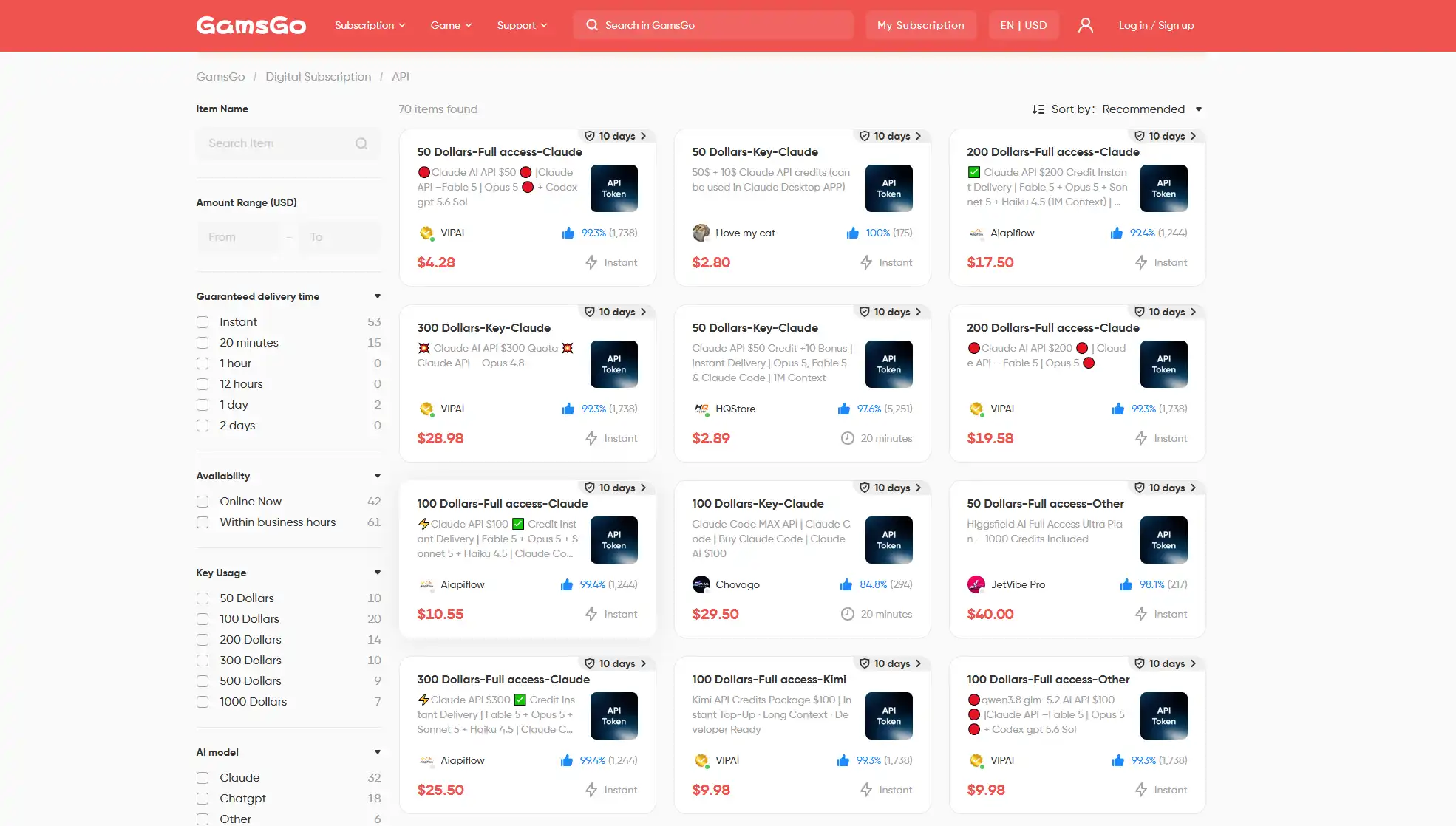
If you are looking for cheap Claude API access, do not compare listings by price alone. Check what the package includes and whether its configuration works with your application or Claude Code.
Is Claude API Worth the Cost?
Claude API is worth the cost when you need to add Claude to an application, automated workflow, AI agent, or development tool. If you only use Claude through its website or app, first consider whether Claude Pro is worth it for your workload.
For cost-sensitive deployment at scale, Haiku is the cheapest current option, while Sonnet provides a practical balance between price and capability. Opus costs more but is better suited to complex coding, difficult reasoning, and high-value tasks.
Your final cost depends on more than the model rate. Input length, output length, request volume, thinking, tool use, and cache hit rate can make two projects using the same model produce very different bills.
If Anthropic’s credit prices or payment method do not fit your budget, GamsGo gives you a more affordable way to access the Claude API. We offer discounted packages with flexible credit balances, fast digital delivery, highly rated sellers, and after-sales protection.
We've prepared an exclusive promo code for all blog readers:
Enjoy an additional 1% off on your next purchase!
Valid across all categories — streaming accounts, AI tools, game top-ups, software subscriptions, and more.
Frequently Asked Questions
Do Claude API Credits Expire?
Prepaid credits purchased directly from Anthropic expire one year after the purchase date and are non-refundable. GamsGo packages may use different validity or warranty periods, which are shown in the individual offer.
Can You Set a Hard Monthly Claude API Budget?
Yes. You can set an organization spend limit below your current usage-tier cap in Claude Console. When that limit is reached, API usage pauses until the next calendar month or until an eligible limit increase is approved.
What Does a 429 Claude API Error Mean?
A 429 error means you exceeded a request or token rate limit, or increased traffic too quickly. Wait for the number of seconds shown in the retry-after header, then retry. Gradually increasing traffic can prevent acceleration limits.
Related Articles
How to Get ChatGPT Plus for Free in 2026
Seedance 2.5 Prices: Is the Subscription Worth It?
LinkedIn Premium Cost in 2026: All Plans, Prices and How to Get 80% Off