Claude has quickly become one of the most popular AI assistants, with around 30 million monthly active users. Its strong writing, coding, and research capabilities make it a go-to tool for students, developers, and professionals alike.
But unlocking its full potential requires a Pro subscription — $20/month, or $17/month if billed annually. Anthropic does offer ways to experience Pro for free through trials, university partnerships, and developer programs, but this information is scattered and often mixed with outdated or exaggerated claims.
We've verified each method and narrowed it down to 11 that actually work. If you'd rather skip the legwork, GamsGo offers Claude Pro accounts starting at ~$5.99/month, and we've included it as an option below.
Let's dive in👇.
📑 Quick Guide: 11 Methods Covered
Full Claude Pro access:
- Guest Pass invite codes (7-day free Pro)
- Official 30-day free trial (new users)
- Claude for Education (university program)
- Claude Campus program (Ambassadors & Builder Clubs)
- Low-cost Pro access through GamsGo
- Claude for Open Source (free Max 20x for maintainers)
- Claude for Teachers (free year for US K-12 educators)
- Promo codes & limited-time offers
Indirect access via API credits:
What's the Difference Between Claude Free and Pro?
Before hunting for free options, it's worth understanding what Pro actually gets you — so you can decide whether you really need it.
The free tier is already quite capable. You get access to Sonnet 5 (the current default model) and Haiku 4.5, along with document uploads, image recognition, basic web search, and Artifacts code previews. For casual use, it's more than enough.
The catch is the usage cap. Free users are limited by a 5-hour rolling window, which translates to roughly 30–100 short messages per day. You also can't access Opus 4.6, Opus 4.7, or Opus 4.8, and you won't get premium features like Claude Code, Cowork, and Research.
Here's how Claude Pro stacks up against the free tier:
| Feature | Free | Pro |
| Usage limits | Rolling 5-hour window only | At least 5x Free per 5-hour session, plus a weekly cap |
| Model access | Sonnet 5 (default), Haiku 4.5 | Sonnet 5, Haiku 4.5, plus Opus 4.8 and earlier Opus models |
| Fable 5 (Mythos tier) | ❌ Not available | ✅ Available, but billed through pay-as-you-go usage credits |
| Claude Code | ❌ Not available | ✅ Terminal, web, and desktop |
| Cowork | ❌ Not available | ✅ Autonomous multi-step task execution |
| Research | ❌ Not available | ✅ Deep web research |
| Projects | ❌ Not available | ✅ Unlimited projects for chats and documents |
| Priority at peak hours | ❌ Not available | ❌ Max plans only |
| Claude for Microsoft 365 | ❌ Not available | ✅ Included |
| Claude Design & Science | ❌ Not available | ✅ Both included |
If you mostly use Claude for quick conversations and simple lookups, the free tier covers the basics. But is Claude Pro worth it? If your workflow involves heavy code debugging, long document analysis, or complex reasoning tasks, the answer is yes — Pro's expanded limits and access to the latest Opus models (including Opus 4.8) make a real difference.
One Note on Fable 5
Claude Fable 5 is Anthropic’s most capable generally available model, positioned above Opus 5 in its current model lineup. Although it is available to Pro subscribers, its usage is not included in the standard Pro plan allowance. Since July 20, 2026, Pro users have accessed Fable 5 through pay-as-you-go usage credits.
Anthropic previously offered eligible Pro subscribers a one-time $100 promotional credit, but the claim window closed on August 2, 2026. Credits that were claimed remain valid until September 17, 2026.
Can You Get Claude Pro for Free in 2026?
Yes, with conditions attached.
Anthropic does not run an always-on free Pro tier. Serving frontier models costs real money, and open-ended free access at that scale is not something any lab offers.
What Anthropic does instead is open premium access through specific channels: invite systems, university partnerships, educator programs, and developer grants. These are real and several of them last a full year or more. Most of them ask you to prove something about yourself first, whether that's your school, your teaching job, or your open source work.
One shift worth noting: broad public trials have mostly disappeared this year, while identity-verified programs have grown. That changes which route is likely to work for you.
How to Get Claude Pro for Free?
Guest Pass Invite Codes (7-Day Free Pro)
This is one of the most straightforward, lowest-barrier options available.
In December 2025, shortly after the release of Opus 4.5, Anthropic launched the Guest Pass feature. Max plan subscribers can generate invite links using the /passes command in Claude Code.
Each Max user gets 3 passes — once they're gone, they don't replenish. Recipients get a full 7-day Claude Pro experience, including access to the latest models and Claude Code for free.
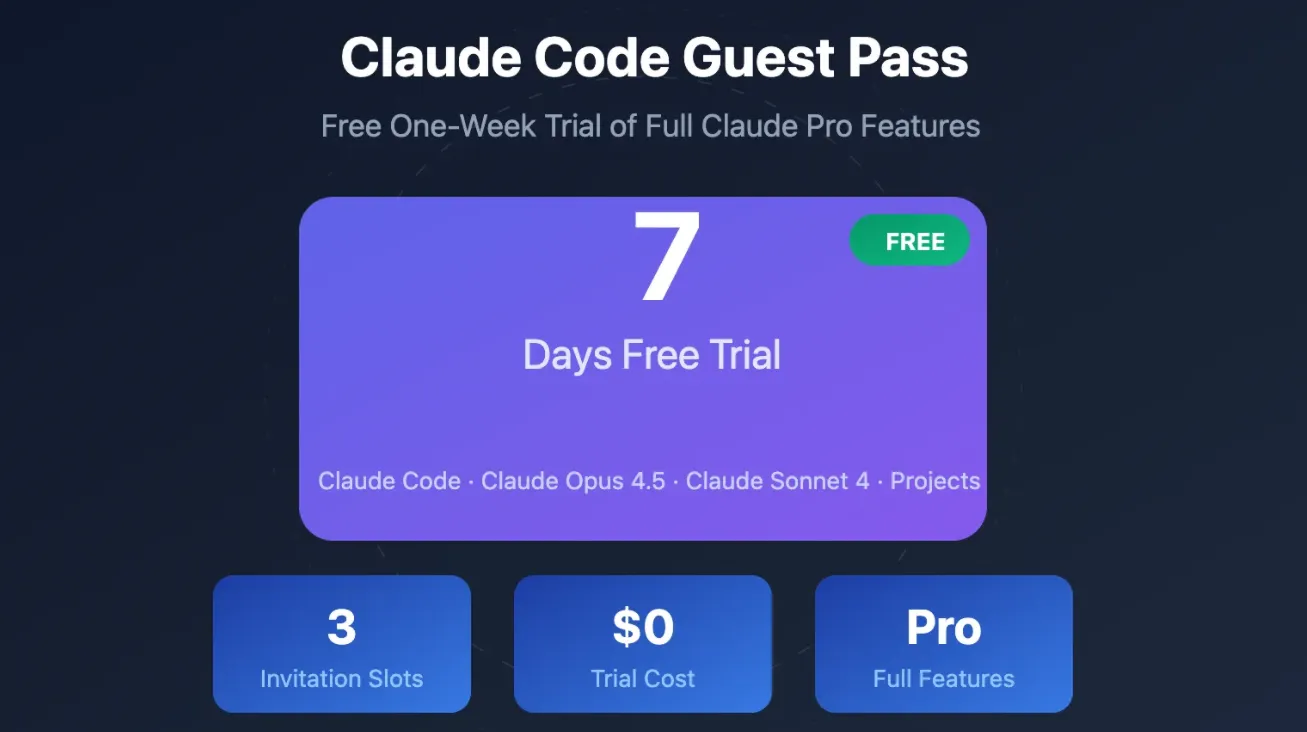
To find a pass, check with friends or colleagues who subscribe to Claude Max. You can also watch for people sharing them on Reddit (r/ClaudeAI), X (Twitter), Discord developer communities, and LinkedIn. Some tech-focused Slack and Discord channels even have dedicated Guest Pass threads.
Keep in mind that Guest Passes only work for accounts that have never held a paid Claude subscription, and activating one typically requires a credit card on file. Be sure to cancel before the 7-day window ends to avoid being charged, and always verify that the link starts with claude.ai/referral/ to steer clear of phishing attempts.
Official Free Trial (Currently Not Open to the Public)
A lot of guides still promise a 30-day Claude Pro trial. As of July 2026, Anthropic's pricing page has no trial entry point, and every call to action reads "Try Claude" rather than "Start free trial."
The mechanism does still exist internally. Anthropic's own promotion terms reference free trials as an account state, which suggests trials get switched on for specific groups or moments rather than running permanently.
Historically these appeared around major launches such as the Claude 4 family and the Opus 4.6 release, delivered through in-app banners, welcome emails, or the upgrade page.
If you want to catch the next one, create a free account now so Anthropic can target you with in-app offers, follow anthropic.com/news, and check claude.ai around product announcements. Treat any site currently advertising a guaranteed 30-day trial link with suspicion.
Claude for Education (University Program)
For anyone searching for the best AI tools for students or a Claude student discount, this is the most reliable long-term route. Anthropic launched Claude for Education in April 2025. Partner institutions buy campus-wide access at negotiated rates, so students, faculty, and staff use premium Claude at no personal cost for as long as they are enrolled or employed.
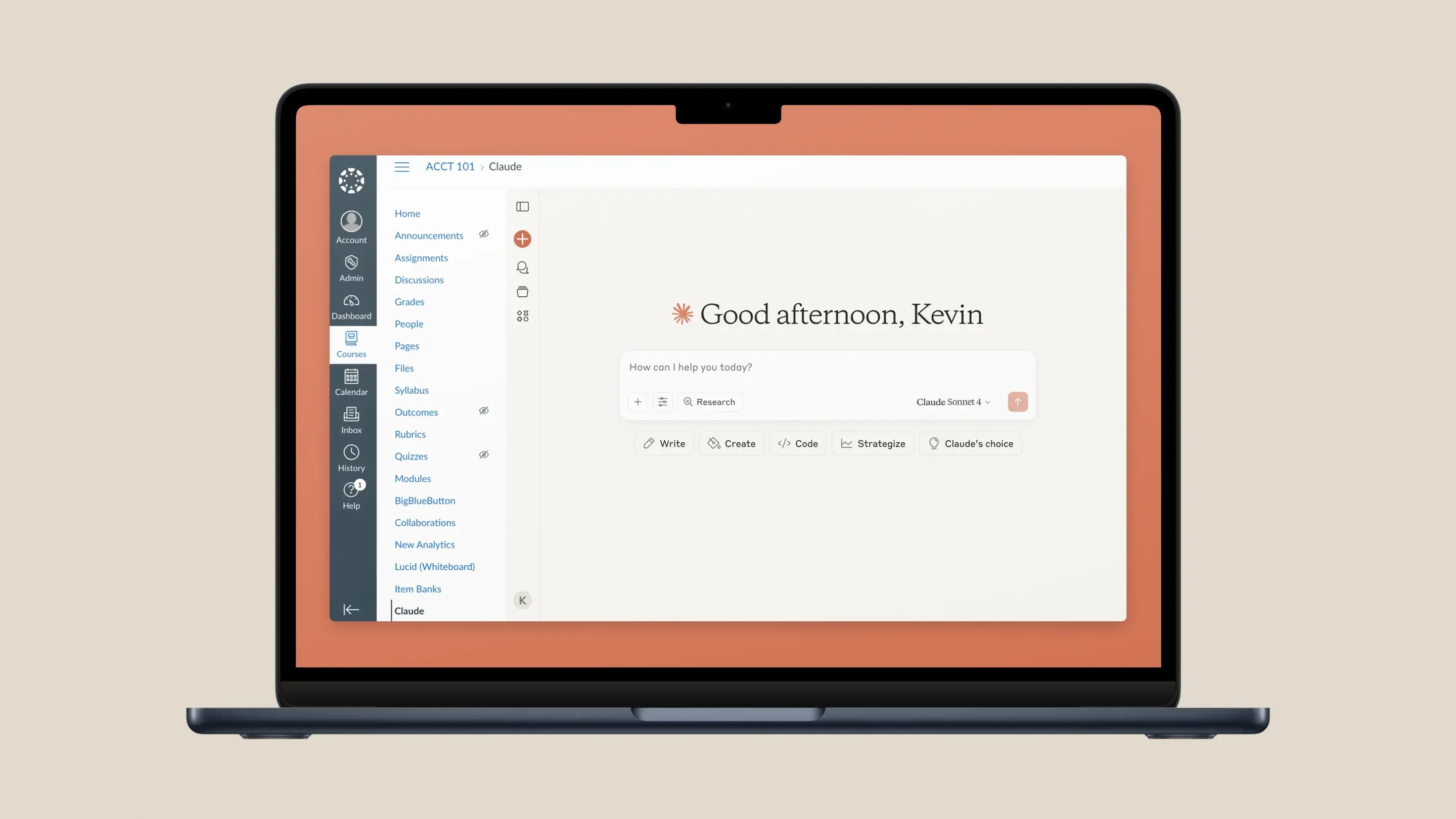
Partners confirmed in Anthropic's own announcements include:
- Northeastern University, Anthropic's first university design partner, covering 50,000 students and staff across 13 global campuses
- London School of Economics
- Champlain College
- University of San Francisco School of Law
- Northumbria University (UK)
The list has kept growing through 2025 and 2026, and Anthropic does not publish a complete public roster. The fastest way to check is to sign in to claude.ai with your school email. If your institution is a partner, the account upgrades on its own. If it does not, your IT department or library services team is the right place to ask about joining.
The program also includes a learning mode that walks students through reasoning instead of handing over finished answers, and it runs under terms where conversations and uploads are not used for model training.
Claude for Teachers (Free Year for US K-12 Educators)
This one launched on July 14, 2026 and most roundups have not caught up with it yet.
Claude for Teachers gives verified K-12 educators in the US free access to premium Claude capabilities. Sign up by June 30, 2027 and you get a full year at no cost. There is no institutional deal required, which is what separates it from Claude for Education. You verify as an individual teacher and you are in.
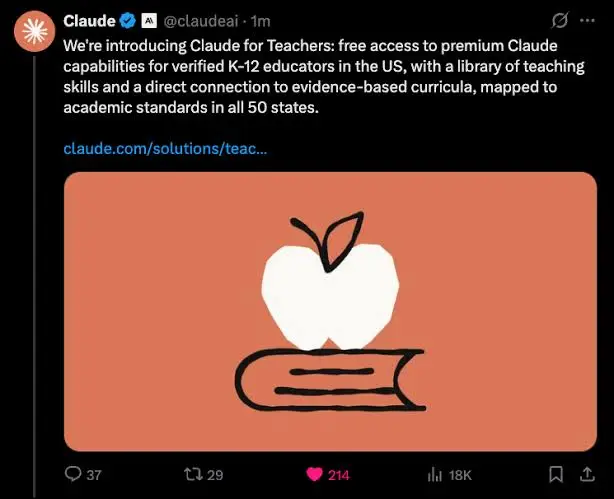
What comes with it:
- Learning Commons connector, which maps Claude's output to academic standards across all 50 states, plus curricula like OpenSciEd and Illustrative Mathematics
- A library of teaching skills built with Learning Commons and refined with classroom teachers, covering lesson planning and differentiation
- Claude Code and Cowork, so you can hand off recurring jobs such as reviewing each day's exit tickets and adjusting tomorrow's plan
- Connectors for K-12 tools including ASSISTments, Brisk Teaching, Canva Education, Diffit, MagicSchool, and TeachFX
On privacy, Claude for Teachers comes with its own teacher terms. Data is not used for model training, and student information falls under a K-12 Data Processing Addendum written to comply with FERPA. Anthropic developed the terms alongside the American Federation of Teachers.
Two limits to know. The program is for educators only and follows Claude's 18-and-over policy, so it is not a student account. And it covers individual teachers, not schools or districts. A district-level offering is still in development, and districts are pointed to Claude for Nonprofits in the meantime.
Claude Campus and Other Student Routes
If your university is not a Claude for Education partner, there are still a couple of student paths worth knowing, though both come with caveats.
Anthropic runs the Claude Campus program at claude.com/programs/campus, split into two tracks:
- Campus Ambassadors: students who work with Anthropic's team on AI education initiatives at their school, in exchange for Pro access and API credits.
- Builder Clubs: student-led groups running hackathons, workshops with Anthropic speakers, and demo nights. Clubs share resources including API credits with members, and the role comes with a program stipend. Open to all majors, not just CS.
Current status as of July 2026: the Spring 2026 cohort is in session and applications are closed. Anthropic has not announced the next intake, so check the campus page rather than relying on secondhand dates. If your campus already has a Builder Club, joining it is faster than waiting for a new application round.
Worth flagging: the old standalone Claude for Student Builders API credit application no longer exists as a separate program. Its page now routes into Claude Campus, so any guide walking you through a separate Student Builders form is out of date.
The GitHub Student Developer Pack is the other student route. It gives verified students free Copilot access with Claude models behind it, but since March 2026, students can no longer pick the model themselves, so Opus and Sonnet are off the menu and Haiku 4.5 is what you get. Fine as a bonus if you already code on GitHub, not a way to reach the top models.
Claude for Open Source (Free Max 20x for Maintainers)
If you maintain open source, this is the most generous program Anthropic runs, and the eligibility bar dropped a lot this month.
Claude for Open Source gives qualifying contributors 6 months of Claude Max 20x free. That is Anthropic's $200/month top individual tier, so roughly $1,200 in value, with full Claude Code access included. No credit card required.
The program launched in late February 2026 with a narrow bar of 5,000 GitHub stars or 1 million monthly NPM downloads. Anthropic widened it on July 8, and the criteria on the live application page now cover five separate paths. You qualify if any one of these describes you:
- Maintainers and library authors: your packages have 500+ dependent repos, 100+ dependent packages, or 200,000+ combined monthly downloads across any registry (npm, PyPI, crates.io, RubyGems, and similar)
- Core contributors: you are a listed committer or maintainer on a recognized foundation or language project such as CPython, the Rust team, Node.js TSC, Apache PMC, CNCF, Kubernetes, the Linux kernel, Django, or Rails
- Active contributors: you have authored 100+ pull requests merged into repos you do not own in the last 12 months
- Community builders: one of your repos has had 20+ unique external contributors with merged PRs in the last 12 months
- Critical infrastructure: any repo you maintain has an OpenSSF criticality score of 0.4 or above
Anthropic also invites people who miss all five to apply anyway and explain what they maintain. Applications go through claude.com/contact-sales/claude-for-oss and are reviewed on a rolling basis, with the program capped at 10,000 recipients.
One practical note: Max 20x is an individual plan, so co-maintainers each need their own application. And when the six months end, accounts with a prior paid plan resume at the old rate unless cancelled, while everyone else drops to Free.
Promo Codes and Limited-Time Offers
Anthropic runs promotions irregularly. Past examples include 50% off Pro for three months through select partner channels, the "Claude 4 Invite Contest" referral sweepstakes, and the $100 usage credit currently going out to Pro subscribers alongside the Fable 5 billing change.
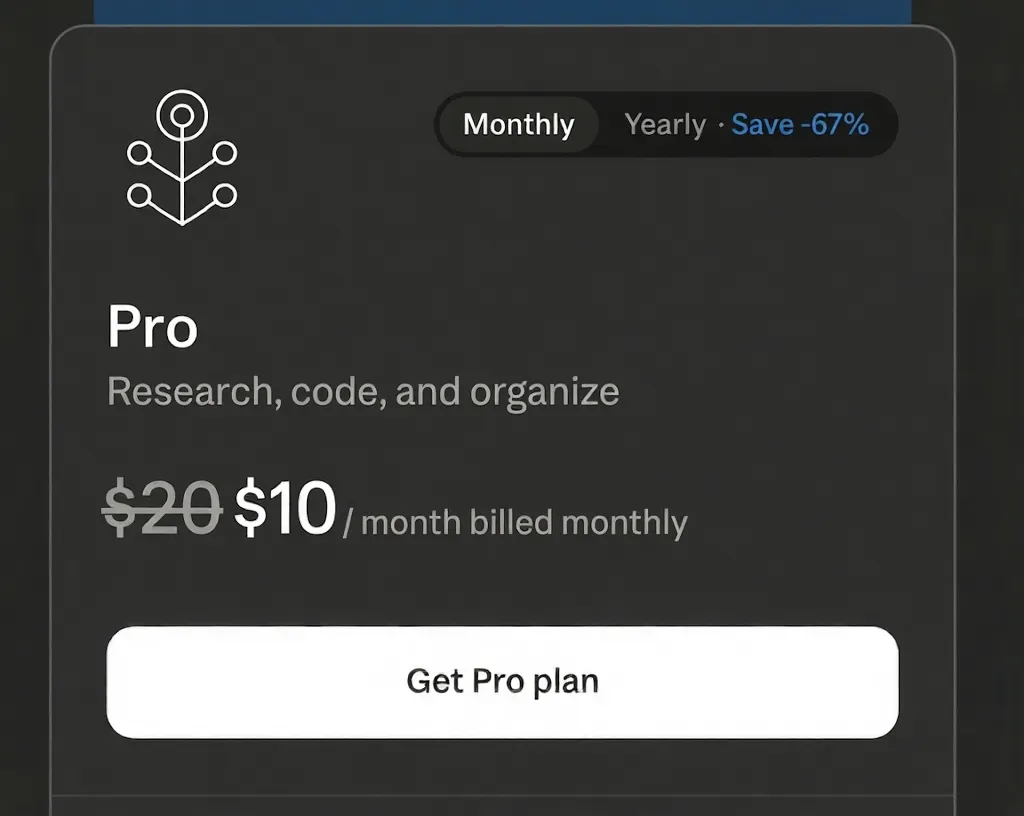
Redeem codes under Billing > Redeem code in the Claude web app. These offers rarely get announced ahead of time, so keeping app notifications on and following the newsletter is the practical way to catch them. Switching to annual billing is the one discount always available, taking Pro from $20 to $17 a month.
Low-Cost Pro Access Through GamsGo
If none of the routes above fit, because you are not a student or teacher, do not maintain open source, and do not want to wait on a Guest Pass, GamsGo is a paid alternative with no application step.
GamsGo is a subscription-sharing platform covering services like Gemini Pro and ChatGPT Plus. Claude Pro accounts runs around $6/month there against the official $20, and you sign up and start using it the same day.
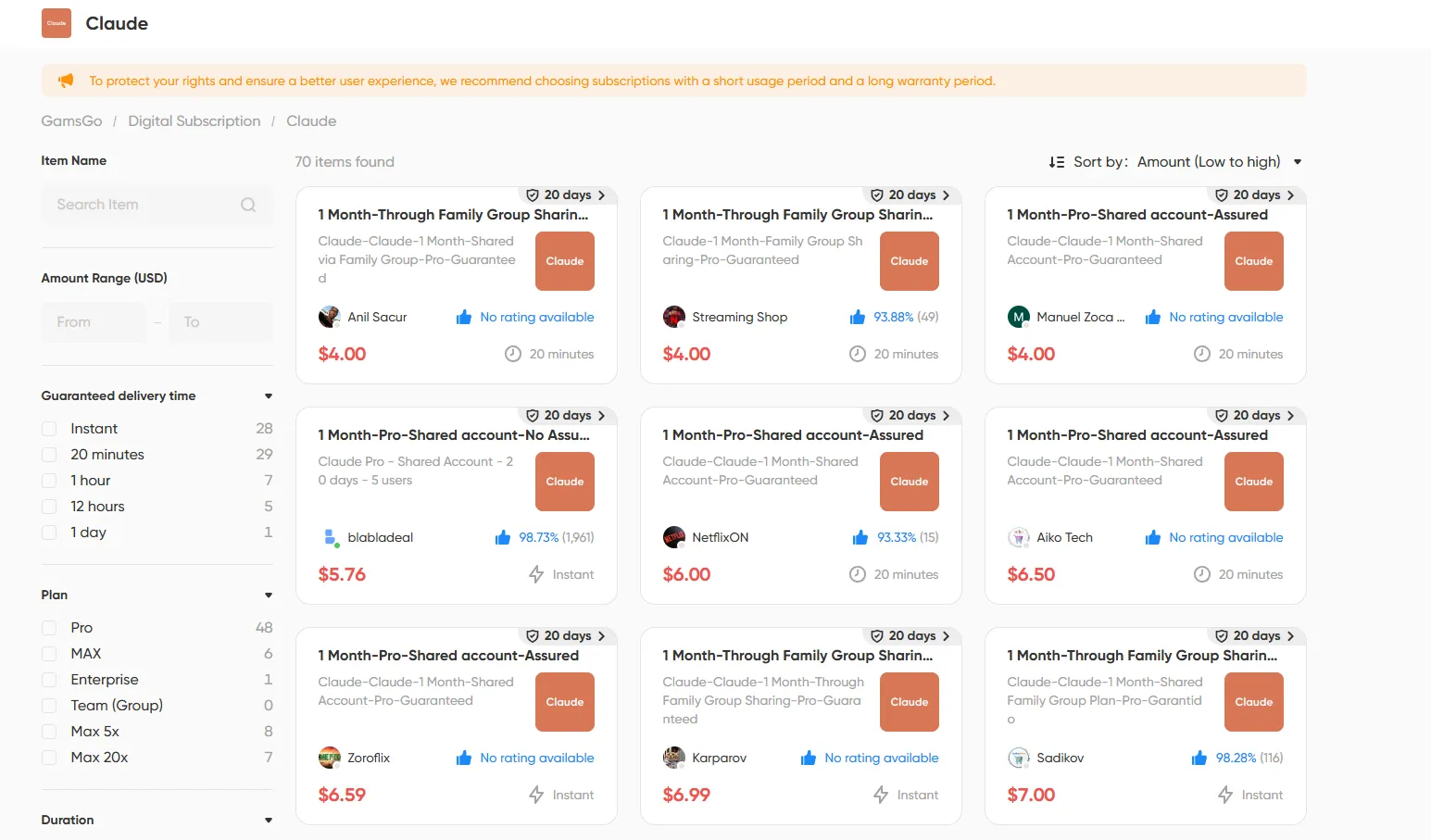
Worth weighing against the alternatives before you decide. Our full Claude discount guide puts coupons, annual billing, and account sharing side by side.
How to Access Claude's Advanced Models for Free?
These next three do not give you a Pro subscription, but they let you call the same models through the API, including Opus 4.8. If you are comfortable with a bit of setup, they are practical alternatives.
Anthropic API New-User Credits
New Anthropic developer accounts come with a small amount of free API credits. Anthropic's pricing documentation no longer publishes a fixed figure, though developers consistently report around $5.
That goes further than it sounds. At Sonnet 5's introductory rate of $2 per million input tokens and $10 per million output tokens, which runs through August 31, 2026 before moving to $3 and $15, it covers a fair amount of testing. Sign up at platform.claude.com, verify your email and phone, and claim the credits from your dashboard.
It is one per account. Phone verification is smoothest with US numbers and less predictable elsewhere. Plan what you want to test before you burn through it.
Cloud Platform Startup Programs
Running a startup opens the largest pool of free Claude usage available anywhere.
Claude runs on every major cloud, so startup credits from those platforms convert directly into Claude API calls:
- AWS Activate offers cloud credits with Claude available through Bedrock. Accelerator participants such as Y Combinator companies tend to receive the larger allocations.
- Google Cloud for Startups gives new accounts $300 in free credits valid for 90 days, usable for Claude through Vertex AI.
- Microsoft Azure provides startup credits, with Claude available through Microsoft Foundry. Confirm with your Azure contact whether your credits cover third-party model usage before you scale.
- Anthropic's own startup program at claude.com/programs/startups offers dedicated API credits and priority rate limits. It currently runs through referrals from Anthropic's VC partners, so ask your investors whether they are in the network.
These do not conflict with each other, so stacking them is fine. Start with whichever cloud you already build on.
External Researcher Access Program
Anthropic provides free API credits to researchers working on AI safety and alignment. Teams apply for a single organizational account and share credits internally.
Applications go through the official form, which you can find by searching "External Researcher Access Program" at support.claude.com. Reviews run monthly, and the program covers released models rather than anything unreleased.
The bar is high, so this suits academic researchers and people already publishing in the safety space. If your interest is specifically jailbreak and robustness work, Anthropic runs a separate Model Safety Bug Bounty Program.
Which Free Claude Pro Method Is Right for You?
With so many options available, picking the right one depends on who you are and what you need. The table below breaks down each method by difficulty, duration, and access level so you can quickly find the best fit.
| Method | Difficulty | Duration | Best For | Key Value |
| Guest Pass | Low, but you need a Max user and a brand-new account | 7 days | First-time users | Full Pro including Claude Code |
| Official free trial | Not currently available | Varies when offered | New users watching for launches | Longest evaluation window historically |
| Claude for Education | Low, granted automatically at partner schools | Length of enrollment | University students and staff | Long-term premium access at no personal cost |
| Claude for Teachers | Low, individual verification only | 1 year, sign up by June 30, 2027 | US K-12 educators | Free premium Claude plus teaching skills and Cowork |
| Claude Campus | Medium, application by cohort | Program duration | Students | Pro access, API credits, and a stipend |
| Open Source Program | Medium, five qualifying paths | 6 months | Maintainers and contributors | Free Max 20x, around $1,200 in value |
| Promo codes and offers | Medium, you have to catch them | Varies | Anyone | Discounts and one-off usage credits |
| GamsGo | Low, sign up and go | Ongoing subscription | Anyone | Around $6/mo, no eligibility check |
| API new-user credits | Low | One-time, around $5 | Developers | Quick way to test the API |
| Cloud startup programs | High, startup credentials needed | Varies | Startups | The largest credit pools available |
| Researcher Access | High, safety research background | Varies | Academic researchers | Free API credits for safety work |
Which one should you pick?
- Want to try Pro this week? A Guest Pass is the only route that works on demand right now.
- Teaching K-12 in the US? Claude for Teachers is a free year and takes minutes to verify.
- University student or staff? Sign in with your school email and see whether Claude for Education upgrades you automatically.
- Contributing to open source? The Open Source program is the highest-value option on this list, and the July criteria change means far more people qualify than before.
- Building a company? Cloud startup programs plus Anthropic's own startup track cover serious volume.
- Working on AI safety? The External Researcher Access Program exists for exactly this.
None of the above, but want long-term low-cost Pro? GamsGo is the lowest-barrier ongoing option.
Conclusion
The shape of free Claude access changed this year. Open trials have largely gone, and what replaced them are programs that ask you to verify who you are: a teacher, a maintainer, a student at a partner school. If you fit one of those descriptions, you can get a year or more of premium Claude without paying anything. If you do not, the free routes have gotten narrower.
At the same time, the paid tiers moved up rather than the free tier moving down. Sonnet 5 landing on the free plan reset the baseline, and the gap Pro buys you now shows up in volume and in agentic tools like Claude Code and Cowork, less in raw answer quality.
That is worth testing before you commit. Spend a week pushing the free tier as hard as you can and watch where you hit the wall. If it is the five-hour window, Pro buys you a lot more room. If it is Claude Code or Cowork, check the free routes above first, since several of them cover both.
When you get there and want to keep it long term, GamsGo runs about $6/month with no eligibility requirements, which is the simplest way to hold onto Pro access for as long as you need it.
GamsGo's Official Extra Discount Is Now Live!
SAVE60 Enjoy an additional 3% off!
FAQ
Will I Be Charged Automatically When the Claude Free Trial Ends?
If you added a credit card when activating the trial, yes — it will typically convert to a paid subscription at $20/month. Make sure to cancel manually at least a day before the trial expires.
Do These Methods Work Outside the US?
Most of them do. Guest Passes and API credits are available globally (though phone verification success rates for the API may vary by region). The Education program depends on whether your university has partnered with Anthropic. Claude for Teachers is limited to US K-12 educators. Cloud startup programs are available in most major markets.
Does the Claude Free Tier Use the Same Models as Pro?
The free tier currently defaults to Sonnet 5 and also offers Haiku 4.5. The Opus family (4.6, 4.7, and the latest 4.8) is exclusive to Pro and higher plans. When using the same model, output quality is identical across tiers — the difference lies in usage limits, model availability, and access to premium features.
Can I Use Fable 5 on a Pro Plan?
Yes, but it's billed separately. Since July 20, 2026, Fable 5 sits outside Pro's plan limits and runs on pay-as-you-go usage credits at $10 per million input tokens and $50 per million output tokens. It's included as standard on Max plans and premium Team seats (up to 50% of weekly limits), and isn't available on the Free plan at all.
Can Students Get Claude Pro for Free?
If your university is part of the Claude for Education program, yes — you'll have free premium access for as long as you're enrolled. Otherwise, you can apply for a Campus Ambassador or Builder Club role for Pro access, or grab a Guest Pass for a 7-day trial.
What's the Difference Between API Credits and a Claude Pro Subscription?
A Claude Pro subscription gives you the full experience through claude.ai, including the visual UI, Projects, and Cowork. API credits let you call the same models programmatically, but require some development setup. For non-technical users, Pro is the better fit; for developers, the API offers more flexibility and cost control.
🔍 You Might Also Like: