AI coding is getting more expensive in 2026. After GitHub Copilot changed its billing in June, some developers reported monthly costs jumping from $29 to $750, and Gartner warns that agentic coding tools can cost $2,000 to $5,000 per developer per month.
Claude Code is one of the tools developers are now watching most closely. In a 2026 survey of 15,000 developers, 46% named it their favorite coding tool, ahead of GitHub Copilot and Cursor.
So the practical question is simple: what does Claude Code actually cost? The answer depends on your Claude plan, model choice, usage limits, token consumption, and whether you use it through a subscription, the API, or both.
This guide breaks down Claude Code pricing in 2026: every plan, real per-task token spend, subscription-versus-API math, and the cheapest legitimate ways to get access, including GamsGo at up to 80% off.

Claude Code pricing in brief Plans: $20/mo (Pro), $100/mo (Max 5x), $200/mo (Max 20x), $22–$110/seat (Team), or pay-per-token on the API. There's no separate Claude Code fee; it's included with any paid Claude plan. Typical cost at scale: about $13 per developer per active day, or $150–$250 per developer a month before optimization. Cost swings wildly with usage: Opus can burn budget several times faster than Sonnet, and a 3-agent session uses roughly 7x the tokens of a single one. Good news: community-tested habits (Sonnet default, /clear, caching) can cut Claude Code token use by 40–85%. |
Claude Code Pricing in 2026
Claude Code isn't a standalone product. It's a terminal tool that runs on your existing Claude plan or API account, and it shares the same usage budget as Claude chat. Here's every way to pay for it in 2026, with a cheaper GamsGo option in the last column.
| Plan | Price | Claude Code | Best for | GamsGo from |
|---|---|---|---|---|
| Free | $0 | No | Chat only | — |
| Pro | $20/mo | Yes | Small codebases | $3.42 |
| Max 5x | $100/mo | Yes | Daily coding | $109 |
| Max 20x | $200/mo | Yes | All-day agents | $50 |
| Team | $22–$110/seat | Yes | 2–150 people | — |
| Enterprise | $22/seat + usage | Yes | Large orgs | — |
| API | Per token | Yes | Automation, CI | $3.98 |
Two things stand out. Claude Code access is included with eligible paid Claude plans, but it is not the same as unlimited usage.
For users who want a Claude Pro account, GamsGo can cut the entry price sharply, with Pro starting around $3.42 per month and Max 20x around $50 for a shorter term.
Is Claude Code Free?
Not on its own. Claude has a free tier, but it does not include Claude Code. The free plan covers chat on web, mobile, and desktop, plus code generation, web search, memory, and file creation. That's plenty for casual use, but it stops short of the terminal coding agent.
To run Claude Code you need at least Pro, or an API key with credits. New API accounts get a small amount of free credit for testing, enough for a few sessions before billing starts.
If you want Claude Code without a monthly commitment, there are cheaper routes. Our walkthrough on getting Claude Code for free covers trials, credits, and the legitimate ways to lower the cost.
How Claude Code Usage Limits Work
Because Claude Code shares one budget with Claude chat, the limits matter as much as the price. Anthropic runs two clocks: a rolling 5-hour window that starts with your first message, and a weekly cap on top. Hit either, and you wait for the reset or pay for more usage.
Everything is measured in tokens (the small chunks of text a model reads and writes; very roughly, one token is about four characters). Max plans have two weekly caps: one across all models, and a separate one for Sonnet only.
What "1x / 5x / 20x" means. Anthropic doesn't publish the exact token allowance for any plan. It only gives a ratio: Pro is the baseline (1x), Max 5x gives five times Pro's room per window, and Max 20x gives twenty times. The estimates below come from community testing, not official figures, and the 5-hour window was doubled on May 6, 2026.
| Plan | Multiplier | Est. tokens / 5h* | ~Prompts / 5h* |
|---|---|---|---|
| Pro | 1x | ~44,000 | 10–45 |
| Max 5x | 5x | ~88,000 | 50–200 |
| Max 20x | 20x | ~220,000 | 200–800 |
*Community estimates, not official. Figures predate the May 6, 2026 change that doubled the 5-hour window, so real headroom is now higher. Actual usage varies with model, context size, and features.
The ceilings rose in 2026. On May 6, Anthropic doubled the 5-hour limits for Pro, Max, Team, and seat-based Enterprise, and removed the old peak-hour slowdowns. In practice, light-to-moderate Sonnet users stay inside Pro, while heavy Opus work on large repos needs Max.
Claude Code Plans for Individual Developers
For solo developers, three plans include Claude Code: Pro, Max 5x, and Max 20x. They differ mainly in how much you can use before hitting a limit. Here's the overview, then a closer look at each.
| Feature | Pro | Max 5x | Max 20x |
|---|---|---|---|
| Monthly price | $20 | $100 | $200 |
| Annual option | $17/mo | No | No |
| Usage vs Pro | 1x | 5x | 20x |
| Priority at peak times | No | Yes | Yes |
| Best for | Light use | Daily use | Heavy use |
Claude Code Pro Cost
Pro costs $20/month, or $17/month billed annually ($200 up front). It bundles Claude Code with the full Claude app, projects, Research, and Cowork. It's pitched for short coding sprints in small codebases, meaning a few sessions a day rather than all-day runs.
| Pros | Cons |
|---|---|
|
|
Claude Code Max 5x Cost
Max 5x costs $100/month, monthly billing only, and gives five times Pro's usage plus priority access when traffic is high. It's the sweet spot for developers who use Claude Code daily on real multi-file work and keep hitting Pro's ceiling before the window resets.
| Pros | Cons |
|---|---|
|
|
Claude Code Max 20x Cost
Max 20x costs $200/month for twenty times Pro's usage, the most any individual plan offers. It's built for power users who run Claude Code most of the workday with agents and heavy Opus use. At this tier, rate limits stop being a daily concern for most professional work.
| Pros | Cons |
|---|---|
|
|
Claude Code Pricing for Teams and Enterprise
For organizations, Claude Code comes with the Team and Enterprise plans. Team suits 2 to 150 people with self-serve setup. Enterprise adds security, admin, and spend controls for larger orgs. Here's how they compare.
| Feature | Team | Enterprise |
|---|---|---|
| Price (annual) | $22 or $110/seat | $22/seat + usage |
| Claude Code | Yes | Yes |
| SSO & admin | Basic | Advanced |
| Audit logs & SCIM | No | Yes |
| Context window | 200K | Up to 500K |
Claude Code Team Cost
Team runs $22/seat standard or $110/seat premium, billed annually, for groups of 2 to 150. Both include Claude Code with usage credits at API rates. Owners pre-purchase credits into a shared pool, then set spend limits at the org, seat, or user level.
Claude Code Enterprise Cost
Enterprise starts at $22/seat annually, with token usage metered on top at API rates. Self-serve prepays credits into a shared pool; sales-assisted is invoiced monthly. It adds SSO, SCIM, audit logs, a 500K context window on some models, and a HIPAA-ready option.
What Teams Actually Spend
Anthropic's own guidance puts typical Claude Code use around $13 per developer per active day, or roughly $150 to $250 per developer per month. About 90% of developers stay under $30 a day, so a few heavy users, not the average, drive most of a team's bill.
How Much Do Real Claude Code Tasks Cost?
Plan multipliers are abstract, so it helps to see what actual work consumes. The table below shows rough token use and API cost per task at current Sonnet rates. The pattern is clear: quick edits are nearly free, while long agentic sessions add up.
| Task | Model | Typical tokens | ~API cost |
|---|---|---|---|
| Quick question | Sonnet | 1,000–3,000 | < $0.01 |
| Single function or bug fix | Sonnet | 5,000–15,000 | $0.02–$0.05 |
| Code review (file + context) | Sonnet | ~60,000 | ~$0.30 |
| Medium-codebase session | Sonnet | 10,000–100,000+ | $0.30–$1.50 |
| Large refactor, multi-file | Opus | 100,000–500,000+ | $2–$10+ |
| 3-agent team session | Mixed | ~7x a single session | Scales ~7x |
The reason costs climb is that Claude Code is an agent, not a chat box. It re-sends the whole conversation on every turn, so a few thousand characters of typing can burn millions of input tokens over a long session. Trimming context is the single biggest lever.
Claude Code Effort Levels and Cost
Effort controls how hard Claude thinks before answering. You set it with /effort, which sizes the thinking budget (private reasoning tokens spent before writing output). More thinking helps on hard problems, but it bills like output, so higher effort costs more.
| Effort | Thinking budget | Best for | Cost impact |
|---|---|---|---|
| None | 0 | Formatting, classifying, high volume | Lowest |
| Low | < 2,000 | Simple edits, quick answers | Low |
| Medium | 2,000–5,000 | Everyday coding, debugging | Moderate |
| High (default) | 8,000–16,000 | Complex logic, agentic tasks | High |
| Max / Ultra | Up to 100,000+ | Genuinely hard problems | Highest |
One honest caveat from real testing: on easy tasks, low, medium, and high effort often produce near-identical output, because the model already knows the answer and doesn't need to think harder. Save high and max for problems that genuinely stump you, and keep everyday work on medium.
Claude Code API Pricing
If you'd rather pay only for what you use, bring your own API key. There's no monthly floor, and Claude Code bills your API account per token. Note that access stops the moment your balance hits zero, with no grace period. Current rates per million tokens:
| Model | Input | Output | Cache read | Best for |
|---|---|---|---|---|
| Opus 4.8 | $5 | $25 | $0.50 | Hard reasoning |
| Sonnet 5 | $2* | $10* | $0.20 | Default coding |
| Haiku 4.5 | $1 | $5 | $0.10 | Fast, light tasks |
| Fable 5 | $10 | $50 | $1 | Long-running agents |
*Sonnet 5 introductory pricing through August 31, 2026, then $3/$15 per million tokens.
A few notes. Cache reads (reusing text Claude already processed) cost about a tenth of fresh input, so caching is a big lever, and batch processing cuts most workloads by 50%. Note too that Sonnet 5 uses about 30% more tokens than older models, which can erase its price edge over Opus.
One change matters for automation. Since June 2026, non-interactive usage, meaning the Agent SDK, claude -p scripts, GitHub Actions, and third-party apps, draws from a separate monthly credit pool billed at API rates: $20 on Pro, $100 on Max 5x, and $200 on Max 20x.
Claude Code Usage Bundles: Prepay and Save
If you regularly go past your plan's included usage, prepaid usage bundles are the official way to cut the overage rate. You buy credit in advance and save up to 30%, and the balance works across Claude, Claude Code, Cowork, and third-party products on your account.
| Bundle value | Discount | You pay |
|---|---|---|
| $50 | 10% | $45 |
| $250 | 20% | $200 |
| $1,000 | 30% | $700 |
Bundles are available on Pro, Max, and Team, bought from Settings then Usage once usage credits are enabled. Bigger bundles save more, and the discount applies automatically at checkout.
Two limits to know. Bundle credits only kick in after you've used your plan's included usage, so they don't replace it. And there's a monthly purchase cap of $2,000 for Pro and Max, or $3,000 for Team, after which extra usage bills at standard rates.
Subscription vs API: Which Is Cheaper?
This is the question most developers really want answered. A subscription gives predictable monthly cost but a hard usage window. The API removes the window entirely, so an all-day run never gets throttled, but the bill scales with every token. The right choice comes down to how you work.
| Usage profile | Per dev / day | Per dev / month | 20-dev team / mo |
|---|---|---|---|
| Typical (Sonnet, short sessions) | ~$13 | $150–$250 | ~$3,900 |
| Heavy (Opus, long sessions) | $30+ | up to ~$450 | ~$9,000 |
| Optimized (routing, caching) | — | 40–85% less | $1,500–$2,500 |
The rule of thumb: if you code most days, a Max subscription usually beats API rates for the same work. If your usage is bursty, automated, or in production, pay-per-token API fits better. Many heavy users keep both, running Max daily and switching to API when they hit a weekly cap.
What Actually Drives Your Claude Code Cost
Whether you're on a subscription or the API, three things move your bill more than the plan you pick. Understanding them is how you stay at the low end of the range.
- Context size. Every file Claude reads and every earlier message is reprocessed each turn, so a long session on a big repo grows fast. Trimming context is the simplest way to stretch a session.
- Model choice. Opus costs several times more than Sonnet for the same task and drains a subscription budget far faster. Defaulting to Sonnet and escalating to Opus only when needed is the easiest saving.
- Agents. Each parallel agent runs its own context, so a 3-agent team can use around 7x the tokens of a single session. Unattended agent chains are the top cause of runaway bills.
A few habits keep these in check. Use /clear when you switch tasks and /compact on long ones, run plan mode before big operations, and check live spend with /cost or /usage. Keeping your CLAUDE.md file under about 200 lines helps too, since it loads into every session.
How to Get Cheap Claude Code
Want cheap Claude accounts or Claude Code without paying full price? A few routes help: annual billing on Pro, student offers, and free trials. Our Claude student discount guide cover those in detail.
That takes a month of Claude with Claude Code to as little as $3.42 for Pro, with Max 5x from $109 and Max 20x from around $50 for a shorter term.
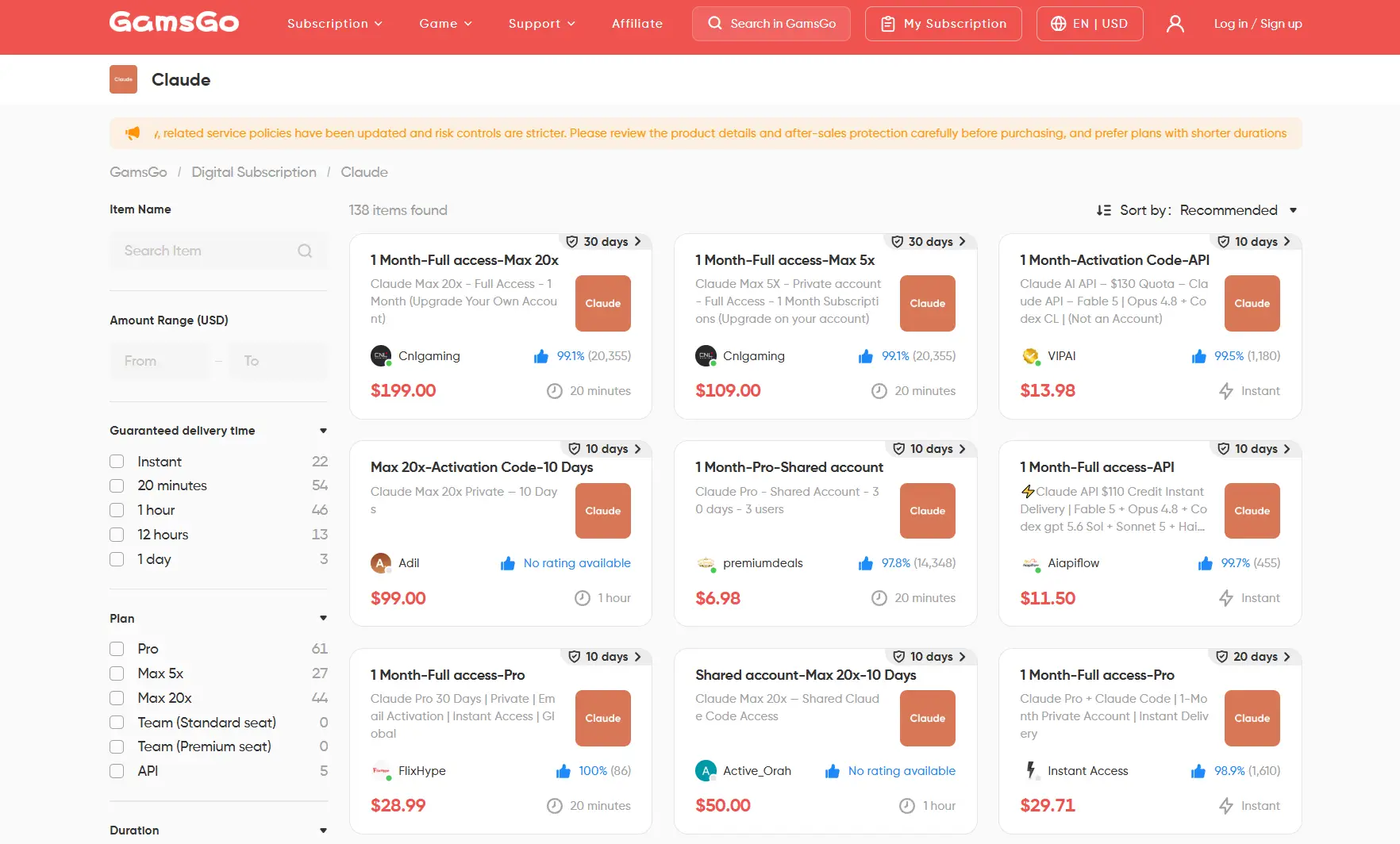
The main advantages:
- Lower prices on real subscriptions. GamsGo focuses on making premium services more affordable, so you typically get the core plan benefits at a fraction of the standard rate. Exact benefits are listed on each product page.
- Self-operated and marketplace options. Self-operated items are managed by GamsGo directly, usually with faster, more consistent delivery. Marketplace items come from vetted third-party sellers and can offer more price choice.
- Multiple secure payment methods. Checkout supports Visa, Mastercard, American Express, Discover, Apple Pay, Google Pay, and regional options like iDEAL and Bancontact, following PCI-DSS standards. Methods vary by country.
- Fast delivery. For self-operated products, access details are usually sent to your GamsGo account automatically right after payment. Marketplace listings show each seller's average delivery time.
- 24/7 support and buyer protection. Reach the help center, live chat, or assistance@gamsgo.com any time. GamsGo vets sellers and uses safeguards like DealShield, though refunds follow platform rules and your order details.
As with any purchase, read the product page, delivery time, seller rating, and refund terms first so the plan matches what you need.
Is Claude Code Worth the Cost?
For most developers coding regularly, yes. Claude Code earns its price on work where the alternative is hours of manual effort: large refactors, migrations, test generation, and understanding an unfamiliar codebase. On a paid plan it adds no extra fee over Claude itself.
It's worth it if you:
- Code most days and want an agent that edits across many files
- Work in large codebases where context and search save real time
- Already pay for Claude and would use the coding tool anyway
You can probably skip it if you:
- Only need occasional autocomplete or light edits
- Rarely run more than a few short sessions a week
- Prefer an IDE-based tool for your workflow
If you're still weighing it up, our take on whether Claude Pro is worth it digs into the value question, and the Claude Pro free guide covers ways to try it at no cost first.
Final Thoughts on Claude Code Pricing
Claude Code itself is free to use once you're on a paid Claude plan. The real cost is set by which plan matches your intensity: Pro at $20 for light use, Max 5x at $100 for daily work, Max 20x at $200 for heavy agent use, or the API for spiky workloads.
Match the plan to how you actually code, keep your models and context lean, and check GamsGo before paying full price, where the same access can cost up to 80% less. Used well, Claude Code pays for itself in saved hours.
We've prepared an exclusive promo code for all blog readers:
Enjoy an additional 3% off on your next purchase!
Valid across all categories — streaming accounts, AI tools, game top-ups, software subscriptions, and more.
Claude Code Pricing FAQ
How Many Tokens Does Claude Code Give Me?
Anthropic publishes multipliers, not exact counts: Pro is 1x, Max 5x is five times that, and Max 20x is twenty. Community testing estimates roughly 44K, 88K, and 220K tokens per 5-hour window, though the window was doubled in May 2026.
Is Claude Code Cheaper on Subscription or API?
For steady daily coding, a Max subscription usually beats API rates for the same work. For bursty, automated, or production use, pay-per-token API fits better. Many heavy users run Max daily and fall back to API when they hit a weekly cap.
Why Did My Claude Code Bill Spike?
Usually heavy patterns: long sessions that reprocess context each turn, Opus on every task, or parallel agents each running their own context. Using /clear, /compact, and defaulting to Sonnet keeps costs down.
Can I Get Claude Code Cheaper?
Yes. Annual billing lowers Pro to $17/month, usage bundles cut overage rates by up to 30%, and platforms like GamsGo sell Claude plans that include Claude Code for up to 80% less, with a month of Pro from around $3.42.
Related Articles
How to Get ChatGPT Plus for Free in 2026
Seedance 2.5 Prices: Is the Subscription Worth It?
LinkedIn Premium Cost in 2026: All Plans, Prices and How to Get 80% Off