As one of the world’s largest online learning platforms, Coursera has more than 200 million registered learners worldwide. But most hit the same wall: you find a course you want, go to subscribe, and Coursera Plus is $59 a month. So you go looking for a discount, and spend twenty minutes on expired coupons that do nothing at checkout.
Coursera almost never runs public codes, which is why that search goes nowhere. The savings are real, but they live somewhere else, in official programs and pricing routes that don't show up as a checkout coupon.
This guide walks through 8 methods that actually work in 2026, covering both Coursera's official routes and third-party options. Or if you'd rather skip the comparison and get the best deal now, you can grab a Coursera Plus account for $2.45 to $9.99 per month through GamsGo.
Let's get into it.

Quick Guide: 18 Methods Covered👇
- Get the current 40% off Coursera Plus
- Save up to 89% with GamsGo
- Switch to annual and save $309
- Get up to 90% off courses with financial aid
- Audit courses for free
- Try Coursera Plus free for 7 days
- Catch a seasonal sale for up to 50% off
- Save up to 75% with regional pricing
How Much Is Coursera?
Coursera's pricing trips people up more than it should, and picking the wrong option is how you end up overpaying before you've even looked at a discount. So it's worth thirty seconds to see how the four ways to pay actually compare. Here's what each one runs.
| Plan | Official price | Free trial | Refund window | Good for |
|---|---|---|---|---|
| Single course | $49 to $79 per course | Audit only | Case by case | One or two specific skills |
| Coursera Plus monthly | $59/month | 7 days | None after trial | Short, intense bursts of study |
| Coursera Plus annual | $399/year ($33.25/month) | None | 14-day money-back | Learning across the whole year |
The free audit is real, but it stops exactly where it counts. You can watch every lecture of Google's Data Analytics or Andrew Ng's machine learning course without paying, then hit a wall at the graded projects and the certificate, the parts an employer actually looks for. Buying that one certificate back costs $49 to $99.
That's fine for a single course. The moment you want two or three, the math flips. Two certificates bought separately can run you $150 or more, while Coursera Plus covers all of them, plus everything else on the platform, for $59 a month or $399 a year. Finish two certificate programs in a year and the annual plan has already paid for itself.
Either way, Coursera Plus is what most people end up paying for, so the real question is how to get it cheaper. That's what the rest of this guide covers.
How to Get Coursera Plus for Less?
1. The Live 40% off Promo
Right now the headline offer is 40% off the first three months of the monthly plan. That takes you from $59 to $35.40 a month for three months, then it returns to the normal $59 unless you cancel. It works out to roughly $70 saved over the three months, and it is open to new subscribers in most countries, though not India, which has its own pricing covered further down.
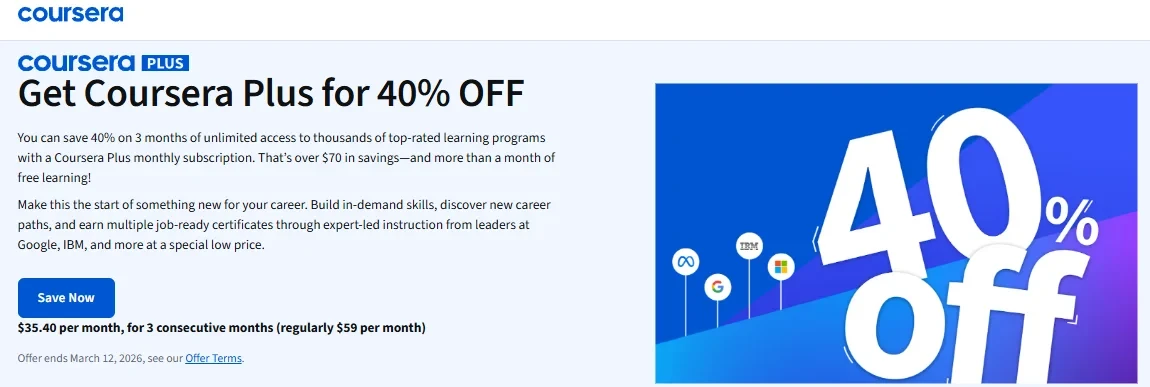
It suits a specific situation: you have a certificate you want to finish inside three months and you would rather not commit to a full year. Set a reminder for when the discounted period ends so the price does not quietly jump back up on you. As with every Coursera promo, it will not combine with a code or another sale.
2. Save Up to 89% with GamsGo Coursera Plus
The official 40% only lasts three months before the price snaps back to $59. For something that holds all year, GamsGo is worth a look, and it's the route I ended up using myself. The annual Coursera Plus plan there is $45 for the year, or $3.75 a month, about 89% under Coursera's $399.
What sold me was how little friction there was: the login showed up in my inbox within minutes, everything on Plus worked, and the one time I had a question, support handled it instead of leaving it on me.
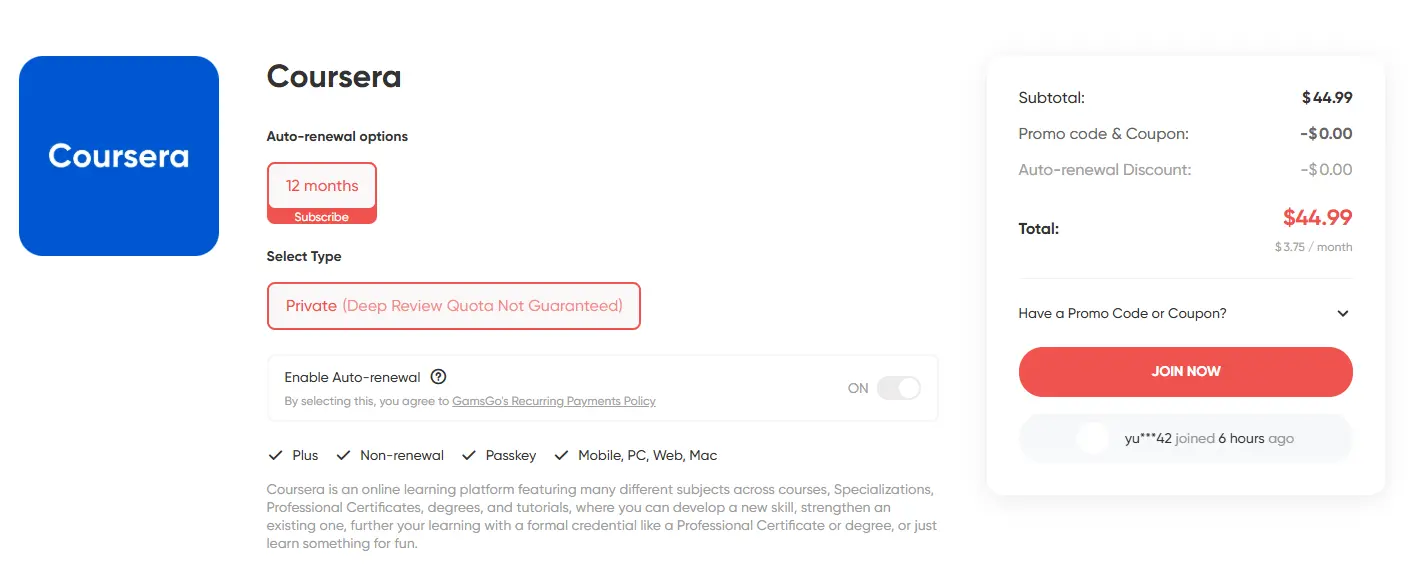
The one tradeoff is paying for twelve months upfront. If you just want to get through a single certificate, the GamsGo Marketplace is the easier fit, with verified sellers listing Coursera Plus plans from $2.45 to $9.99 a month.
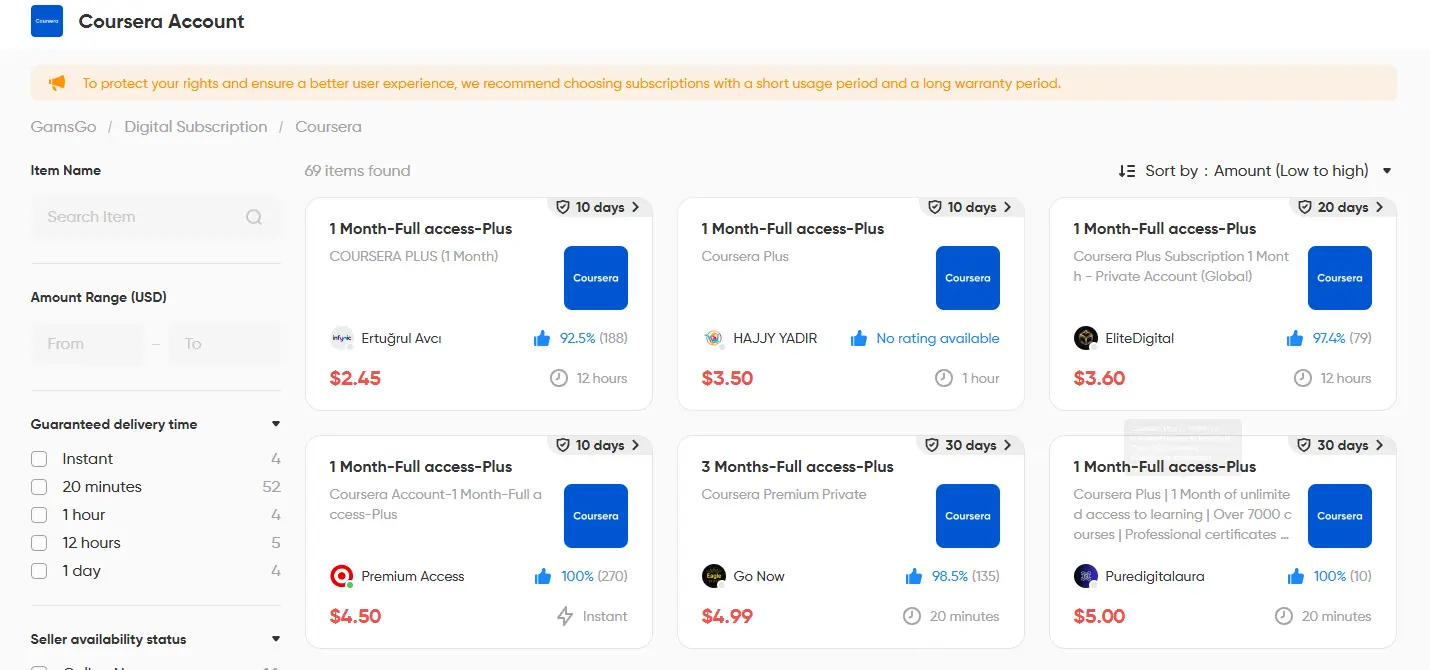
Those are private accounts, so your progress and certificates stay yours, and the payment sits in escrow until you confirm it works, which makes trying a single month pretty low risk.
3. Switch to Annual and Save $309
The plainest saving here is picking annual over monthly. Twelve months of the $59 monthly plan costs $708. The annual plan is $399, so you keep $309 and effectively get around five months free. The break-even point lands near seven months, so if you expect to use Coursera past summer into the new year, annual wins clearly.
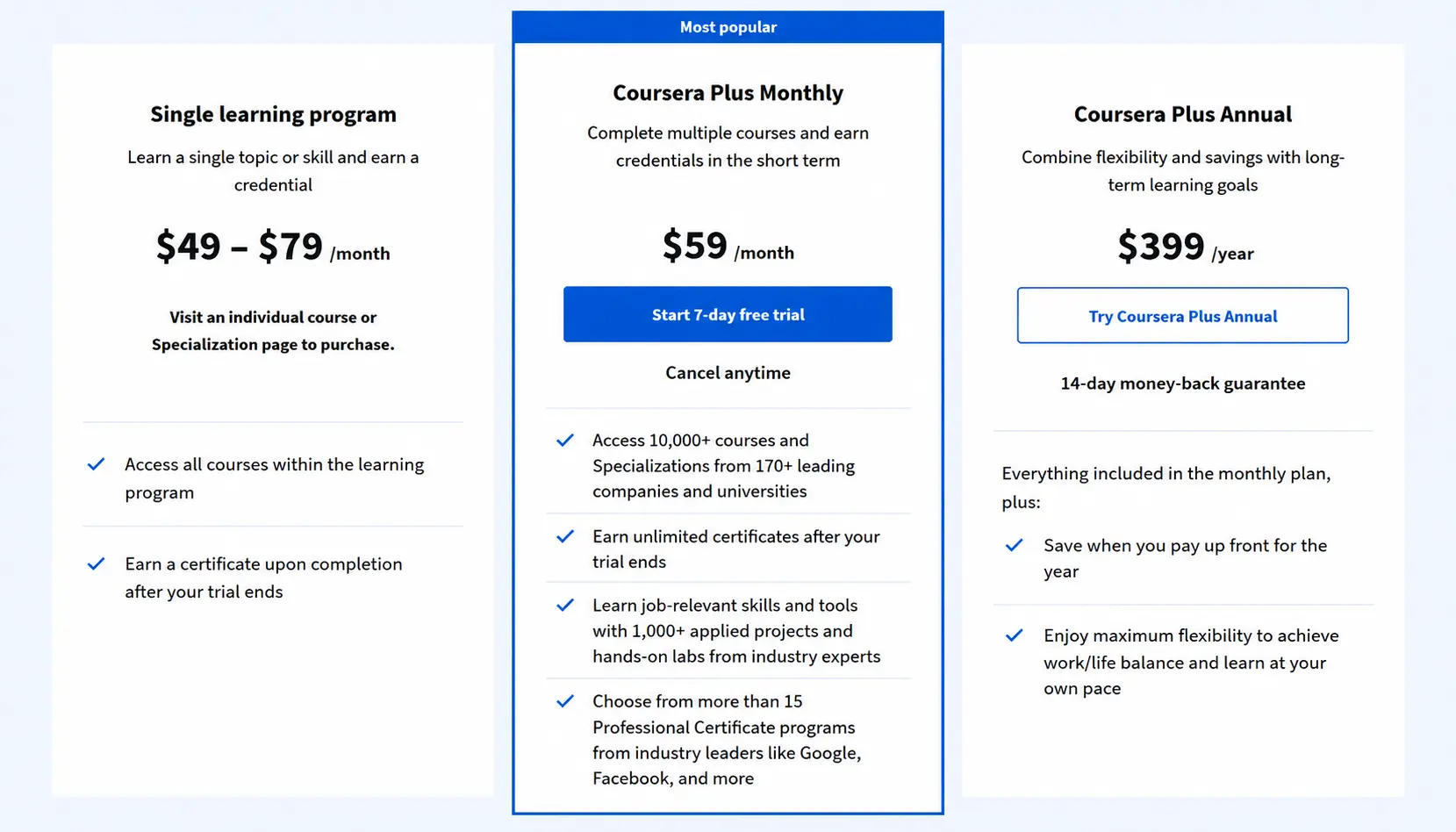
Paying $399 in one go is a real commitment, and it only pays off if you keep studying. If you are new to the platform, start on the monthly plan for a month, see whether you stick with it, then move to annual once the habit holds. The 14-day money-back window on the annual plan gives you a bit of cover if you change your mind early.
4. Get Up to 90% Off Courses with Financial Aid
This is the route people miss most often, and it is genuinely generous. Coursera offers need-based financial aid on individual courses and Specializations, and an approved application can cover up to around 90% of the fee, sometimes the full amount. It is free, you never repay it, and it has no effect on anything like your credit.
You apply on the course page itself. Look for the "Financial aid available" link near the enrollment button, fill in the short form explaining why the cost is a barrier, and wait for a decision, which usually comes back within about 15 days.
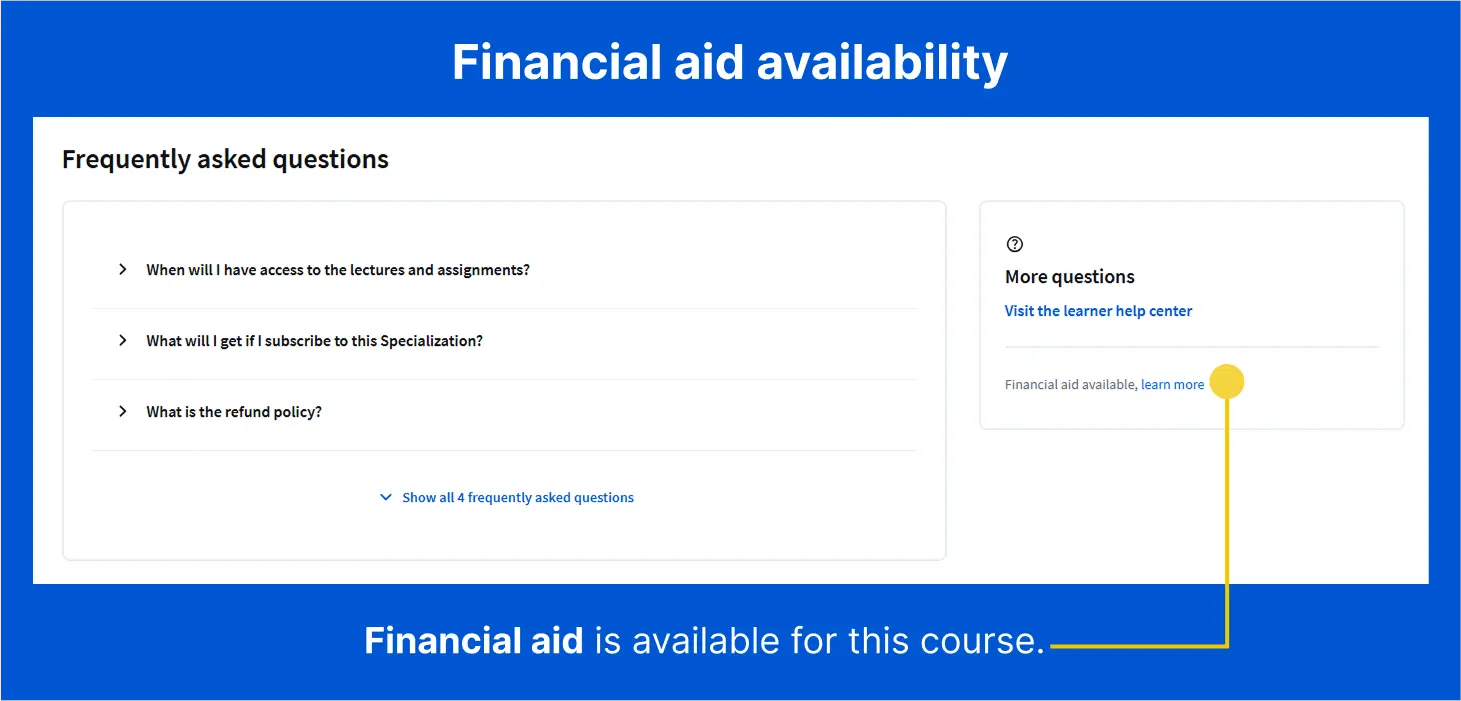
Two things to keep straight: aid applies to specific courses and Specializations, not to a Coursera Plus subscription and not to degrees. So if your goal is one or two named certificates rather than unlimited access, this often beats every subscription discount on the page.
5. Audit and Preview Courses for Free
You can still learn a lot on Coursera without paying, though how much depends on the course. Many individual courses, especially older ones, offer an audit option that gives you the video lectures and readings at no cost.
You skip the graded assignments and you do not get a certificate, but for building knowledge or testing whether a topic is for you, it does the job.
Coursera has been changing this. On a growing number of newer courses, the old audit view has been replaced by a preview that only opens up the first module for free, graded items included, before asking you to enroll.
So the practical move is to open the course you want and look for the audit link near the enroll button. If it is there, take it. If you only see a first-module preview, pair it with the 7-day trial or financial aid to go further.
6. Try Coursera Plus Free for 7 Days
New users can start a 7-day free trial on the monthly Plus plan. For that week, you get the full catalog, so it is enough time to run a course or two through your real schedule and see whether the platform fits how you like to learn.
You will need to add a payment method to start it, and the first monthly charge hits the moment the week ends, so a calendar reminder the day before is worth setting.
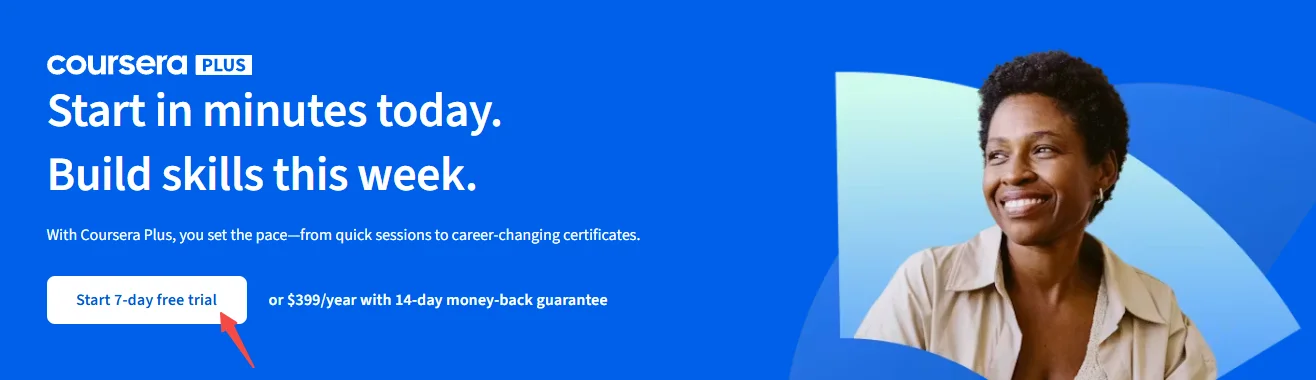
One thing the trial does not cover for free is the certificate itself. You can watch everything and do the work during the trial, but claiming the certificate still means paying for the course. If a certificate is the whole point, the trial is better used to test the platform than to try to grab credentials in seven days.
7. Catch a Seasonal Sale for Up to 50% Off
Coursera runs its deepest cuts around two moments: New Year in January and Black Friday and Cyber Monday in late November. In past January sales, the annual plan has dropped to around $199, which is close to half off, and Black Friday has landed near 40% off the annual price. These are for new subscribers, and they do not stack with anything else.
If you are reading this outside those windows, you will usually still find a smaller promotion running rather than nothing at all. The percentage moves around, so the honest advice is to open the official offers page and check the number live before you buy.
If a bigger sale is only a few weeks out and you are not in a rush, waiting for it is the single easiest way to pay less.
8. Save Up to 75% with Regional Pricing
Coursera prices its plans differently by country, and the gap is large. In India, for example, the annual Coursera Plus plan lists near ₹13,999 and regularly goes on sale for roughly ₹6,999 to ₹7,999, which is far below the US price once you convert it.
During its biggest regional promotions, Coursera has gone as deep as around 75% off in India and roughly 65% across parts of Latin America, Europe, and Asia Pacific.
This is real localized pricing built for purchasing power, not a loophole. If you live in one of these regions, make sure you are subscribing through your local Coursera site so the local rate actually applies.
It is worth saying plainly: trying to fake a cheaper country with a VPN runs against Coursera's terms and can trip up payment, so this one is for people the pricing is genuinely meant for.
Which Coursera Discount Is Best for You?
The right choice depends less on the biggest headline number and more on how you actually plan to use Coursera. Here is how the ten stack up side by side.
To make it quick:
- You only want one or two certificates. Apply for financial aid on those specific courses, and audit anything you just want to watch. You may never need a subscription at all.
- You want unlimited access at the lowest price. GamsGo's annual plan at $45 a year, or $3.75 a month, is the cheapest way to get full Coursera Plus. If you'd rather buy direct from Coursera, go annual and time it with the January or Black Friday sale.
- You only need a month or two. Skip the annual commitment and grab a monthly plan on the GamsGo Marketplace, $2.45 to $9.99 a month, on a private account that stays yours with escrow and a warranty behind it.
- You're on a tight budget right now. The current 40% promo drops Plus to $35.40 for three months, and financial aid can cover individual courses almost entirely while you get going.
- You're a student. There's no separate student discount, so check whether your university partners with Coursera for free access, then lean on financial aid for individual courses.
The Short Version
Coursera lets you learn from Google, Stanford, and Yale and come away with a certificate employers respect. That's worth paying for, just not at full price.
There's no public coupon that helps, so the savings come from matching a method to how you learn: financial aid or audit for a single course, the annual plan or a seasonal sale for the long haul, local pricing if Coursera charges less where you are.
Or skip the comparison: GamsGo gets you full Coursera Plus for $45 a year, ready minutes after you order. We keep this guide updated and post new savings on the GamsGo blog, so check back before your next renewal.
FAQ
Does Coursera Offer a Student Discount?
No, there is no dedicated student discount code. Students save the same ways everyone else does: through financial aid on individual courses, university partnerships that grant free access, and the general promotions that are open to all. If your school works with Coursera, that is usually the best deal available to you.
Is Coursera Plus Worth It?
It depends on volume. Since individual courses run $49 to $79, the $399 annual plan pays for itself once you complete more than five or six courses in a year. For steady learners and career switchers taking several certificates, it is easily worth it. If you only plan to finish one or two, buying those courses on their own, with financial aid, is cheaper.
Can I Get Coursera Plus for Free?
Not the full subscription on an ongoing basis, but you can get close for individual learning. Financial aid can cover a course entirely, audit gives you free lecture access on many courses, and the 7-day trial opens the whole catalog for a week. Employer reimbursement can also cover the cost if your company offers it.
What Is the Cheapest Way to Get Coursera Plus?
For unlimited access, GamsGo Coursera Plus at $3.75 a month is the lowest steady price. Among official routes, the annual plan bought during a January or Black Friday sale is the cheapest, and regional pricing beats both if you live in a lower-priced country.
Does the Discount Work on the Annual Plan?
The seasonal sales apply to the annual plan, and they are where the annual price drops most, sometimes to around half. The current 40% promo is tied to the first three months of the monthly plan instead, so read which plan an offer covers before you check out.
Is Coursera or Udemy Cheaper?
Udemy is usually cheaper per course and runs frequent sales, which suits picking off single practical topics. Coursera costs more but gives you university-backed courses and recognized certificates, and Coursera Plus turns unlimited learning into better value if you study a lot. For credentials that carry weight with employers, Coursera is the stronger spend.
Related articles